

Is Rouvy the "Most Realistic Cycling App in the World"?

This morning, Matt rode through a massive redwood forest on The Avenue of the Giants in California. He finished just time to see his first patient about an hour later, here in Florida.
How’s that possible?
He was riding on an indoor cycling platform called Rouvy.
So, as he rode through the misty morning fog underneath 250-year-old redwoods, he was actually riding on the trainer, next to me, in our cycling room at home.
Historically, I’ve always hated riding on the trainer. For me, part of the joy that comes from cycling is being outdoors and exploring the great, wide world on two wheels.
But I have to admit there are times when a structured workout done indoors can be beneficial, from both a training standpoint and from a “getting-to-work-on-time” standpoint.
Still, wouldn’t it be great if riding indoors felt more like riding outside?
That’s why we decided to try Rouvy, which has been described as “the world’s most realistic indoor cycling app.” We’ve been using Rouvy for the past 2 months to learn all the ins and outs so we can provide you with a behind the scenes look and explain what it’s all about!
*We also have a special gift for you, so read to the end…
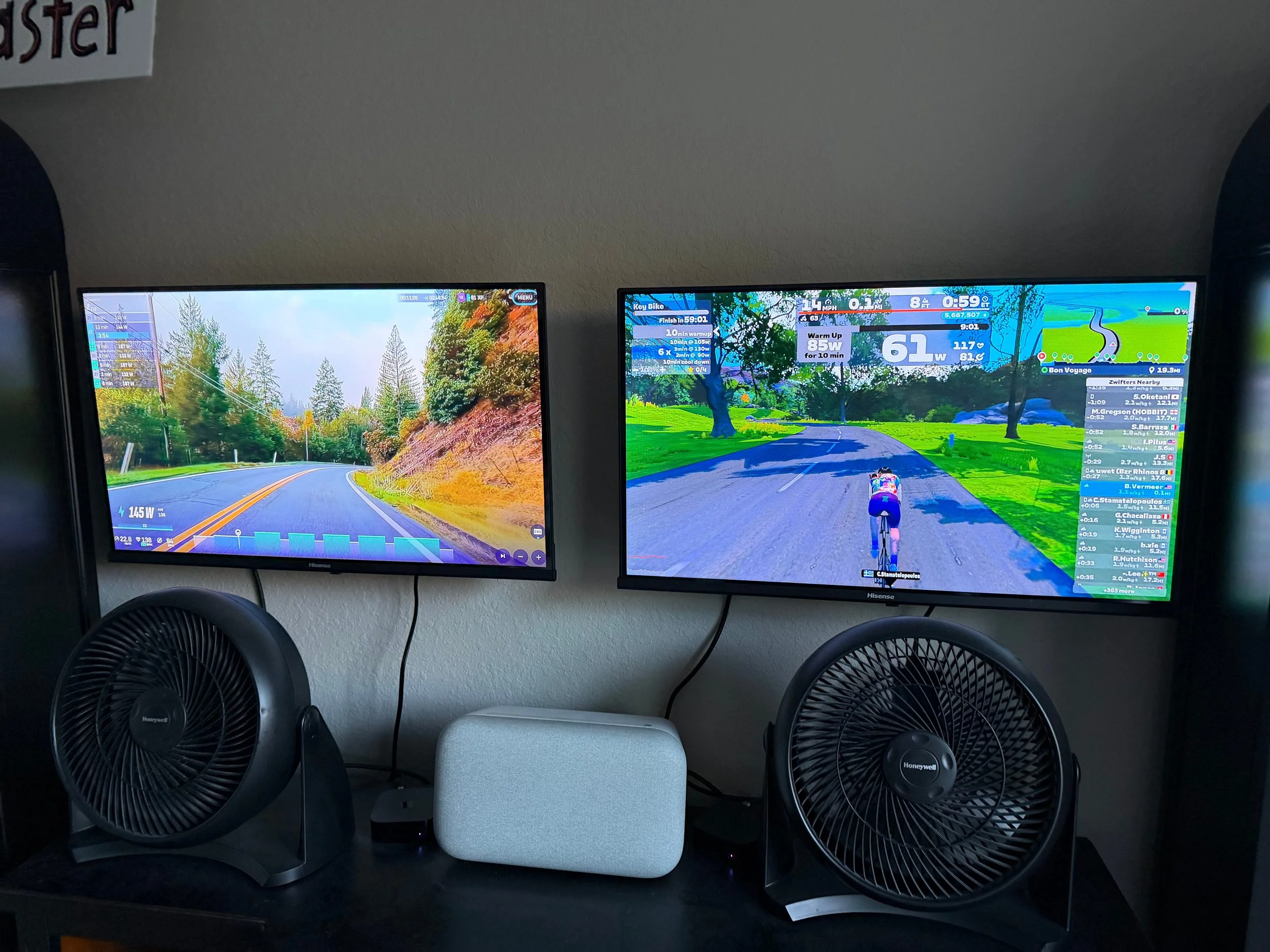
Here’s a side-by-side comparison with Rouvy on the left and Zwift on the right.
What’s Rouvy?
There are plenty of cycling apps out there (Zwift, TrainerRoad, Wahoo SYSTM, ect.) and each has their own thing. For example, Zwift is all about gamification, so it looks like a video game with animated visuals, segment leaderboards, and sound effects.
In contrast, Rouvy provides a more immersive experience with realistic routes that were filmed on locations in different countries around the world. They have more than 3,500+ courses, including some of the most iconic cycling routes in France, Italy, and Switzerland.
You can ride the legendary 12 bends of the Alpe D’Huez, the steep bergs of the Tour of Flanders, or the cobbled roads of Paris-Roubaix. You can take on the dusty, gravel roads of the Strade Bianche in Tuscany or ride around Lake Garda in the Italian mountains. You can even attempt the infamous Col du Galibier to 2,600m. Be sure to keep an eye out for marmots!
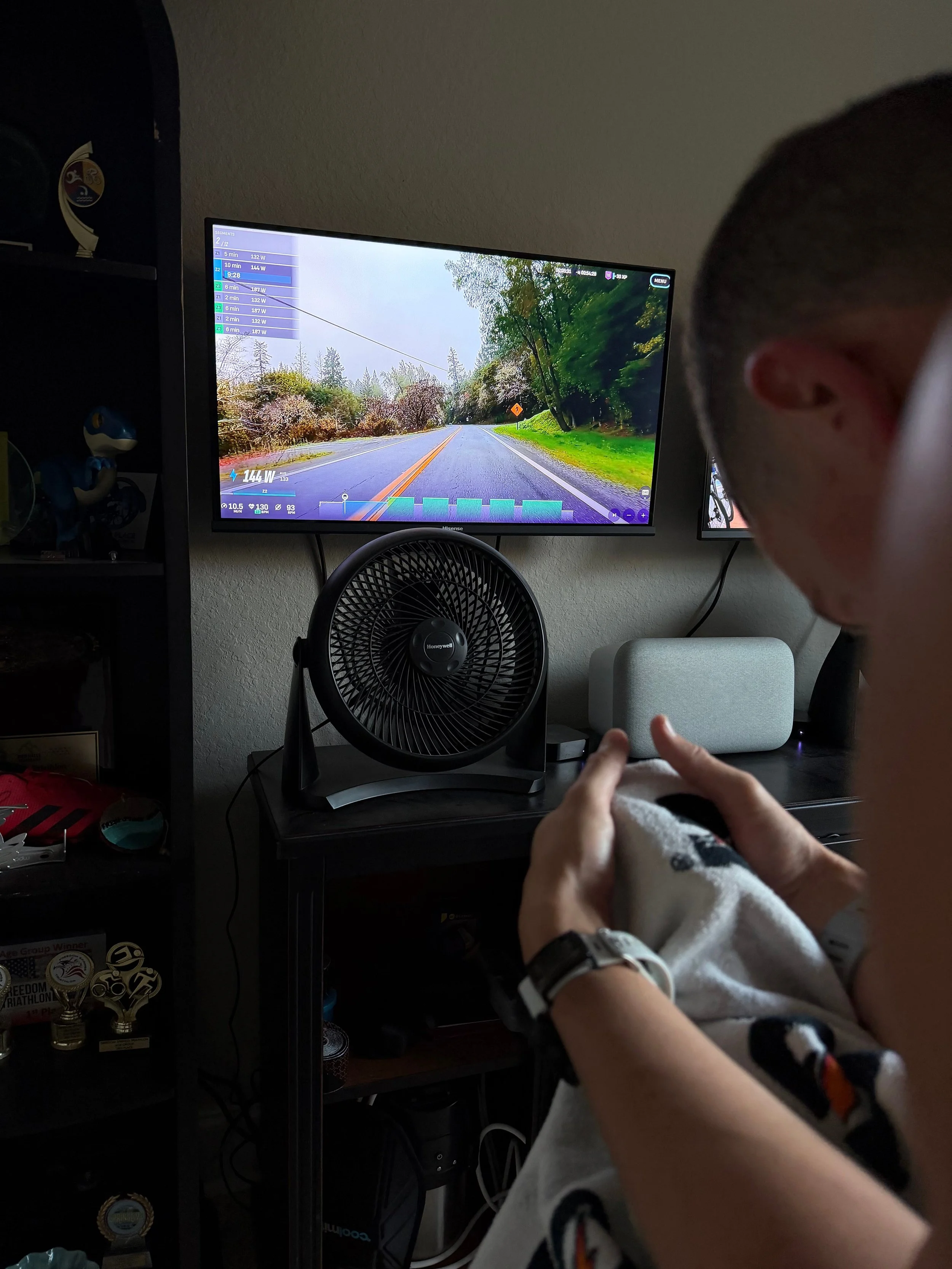
Here’s Matt riding on The Avenue of the Giants in California.
What do I need to use Rouvy?
All you need to use Rouvy is an account, a device with a screen, and a bike trainer. You can use a smart bike, direct drive, or classic trainer, including Wahoo, Elite, TacX, ect. The platform supports a wide range of devices like Windows, Mac, iOS, Android, and Apple TV, so you can use it on your computer, iPad, or phone.
But you aren’t just riding your bike and watching a movie. It’s interactive. Rouvy connects with your bike trainer and adjusts the resistance to the gradient of the route you’ve selected. So, when you’re riding up a mountain, it feels like you’re actually climbing!
Rouvy also supports virtual shifting, which simulates gear changes on your smart trainer without having to manually shift your bike (ERG mode) or you can shift gears yourself (non-ERG mode).
Rouvy also syncs with Training Peaks, Strava, Garmin Connect, TriDot, and more, so you can upload your coach’s workouts directly into the platform. There’s also sessions from your favorite cyclists, like Wout Van Aert and Mads Pedersen, and pro triathletes like Sam Long, Frederic Funk, and Nikki Bartlett. Occasionally, they even have group rides you can join in on- like one last week with Patrick Lange.
There’s distance-specific training plans (70.3, ect.) with over 600 workouts to choose from. Also, Rouvy is the Official Digital Sports Platform for IRONMAN, so you can ride on actual routes to do some recon before your race!
Why is Rouvy helpful for triathlon training?
The biggest reason Rouvy is popular with triathletes is because it has actual bike courses from 70.3 and IRONMAN events around the world. This is an amazing feature, because you can experience portions of the course prior to race day. Because the footage you see was actually filmed on course, you can pick out landmarks and get to know the terrain of the course, like where hills are located, how long they last, and how technical a descent might be.
Here in the US, you can ride on 70.3 Eagleman, 70.3 Wisconsin, and 70.3 Coeur d’Alene. You can take on IRONMAN Maryland, IRONMAN Lake Placid, and even Kona.
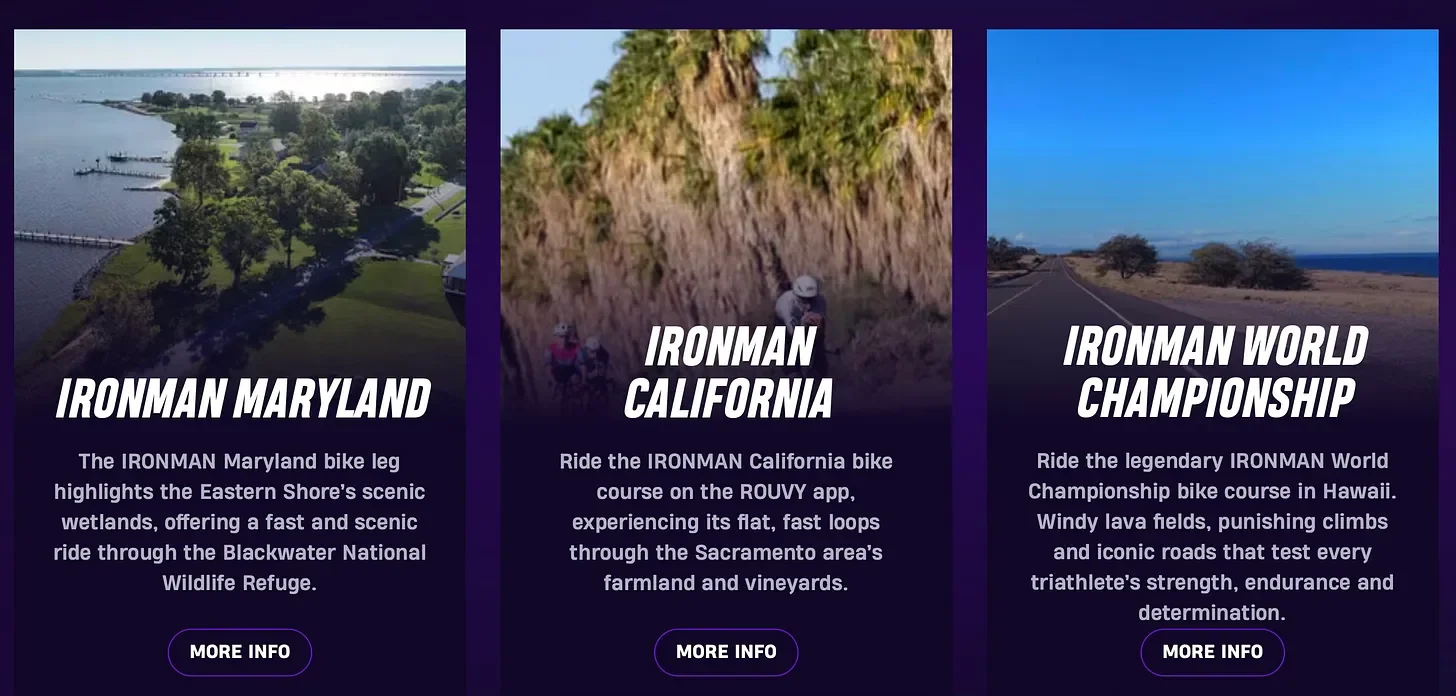
In Western Europe, you can ride 70.3 Weymouth, IRONMAN Hamburg, and IRONMAN Nice. In Northern Europe, you’ve got IRONMAN Kalmar and the 70.3 European Championship course. In Southern Europe, there’s 70.3 Venice. In Central Europe, you can try your hand at IRONMAN Austria. There’s also IRONMAN Western Australia, IRONMAN South Africa, and Challenge Roth.
They add new courses all the time. In fact, several new routes were announced in November, including IRONMAN Frankfurt, 70.3 Swansea, 70.3 Bolton, IRONMAN California, 70.3 Valencia, 70.3 Duisburg, IRONMAN Canada-Ottowa, and IRONMAN Brazil.
Matt rode on the 70.3 Augusta course before we raced there earlier this year. He also rode portions of the course in Marbella prior to the 70.3 World Championship last month. Because we live in Florida, it was a great opportunity for him to see some of the climbs he’d encounter in Spain prior to race day.
Here’s his feedback about Rouvy:
“I was unsure how I would like the live video vs my experience with other virtual platforms. I’ve found the experience to be far more engaging and immersive. Also, the integration with TrainingPeaks makes structured workouts easy to do.”
“I especially like riding on real-world IRONMAN courses as a recon ahead of races. It’s also been fun to ride courses and relive past experiences.”
Pros and Cons of Rouvy
After using Rouvy for two months, here’s a recap of our experience.
Pros
We really like being able to ride realistic courses, especially as a recon opportunity for upcoming races. Also, being able to ride on beautiful routes in Italy, France, and Switzerland helps keep indoor cycling interesting.
Matt’s only critique is that he can get distracted looking at the scenery and miss the intervals changing during his workouts!
I personally enjoy the more pared-down visuals, as opposed to other platforms, because it’s less distracting. When you look at the screen on Rouvy, you see a few things. There’s the video of the route, as well as helpful metrics.
We mostly do uploaded workouts from Training Peaks, and with this feature you can see the workout graph at the bottom of the screen and each segment of the workout in a sidebar on the left side of the screen. In the bottom left hand corner, there’s metrics like power, heart rate, cadence, and speed. In the upper right hand corner, you can see how many minutes are left in your workout.
Also, it’s great to have the double subscription option, especially since we both need an account.
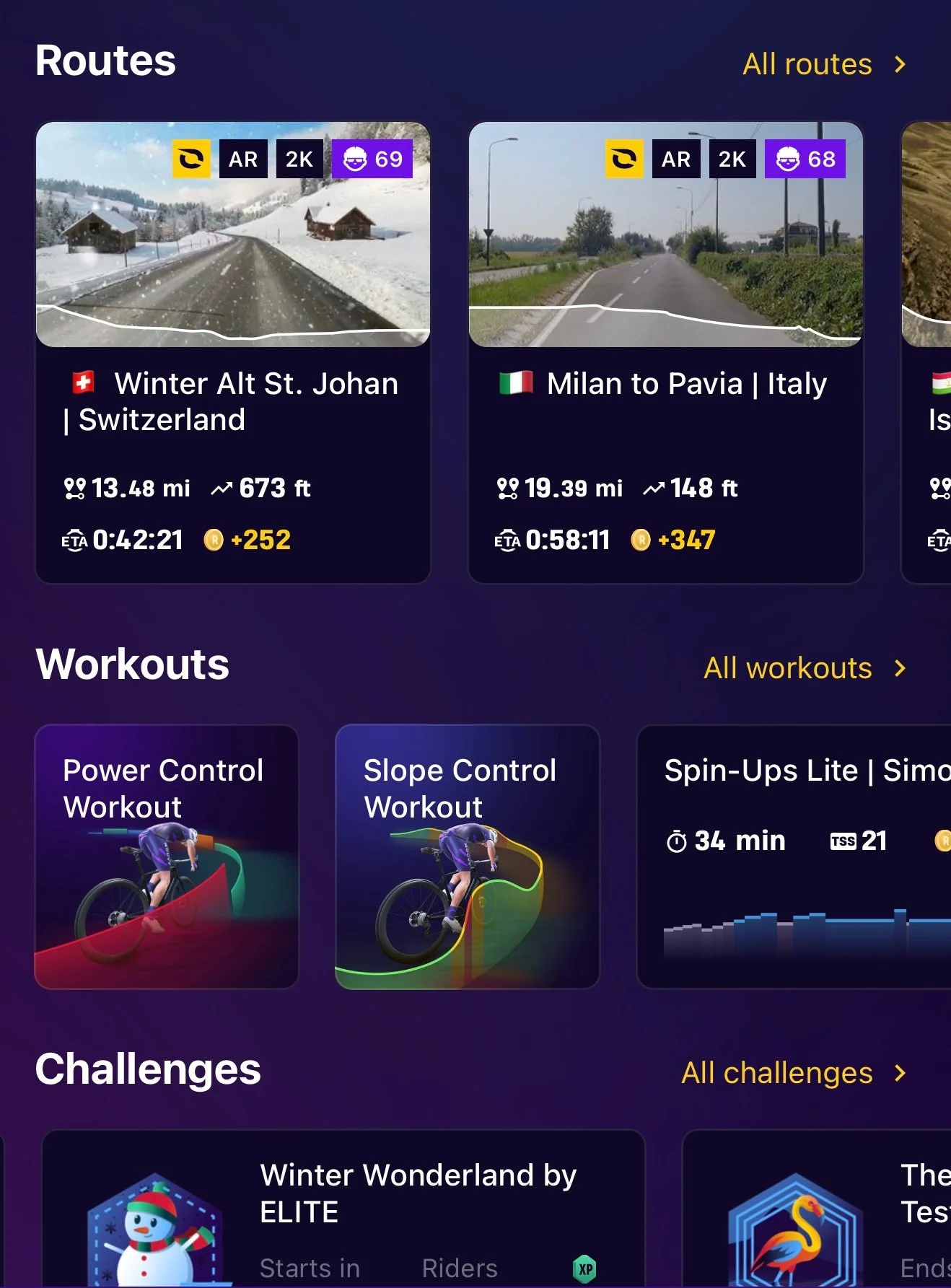
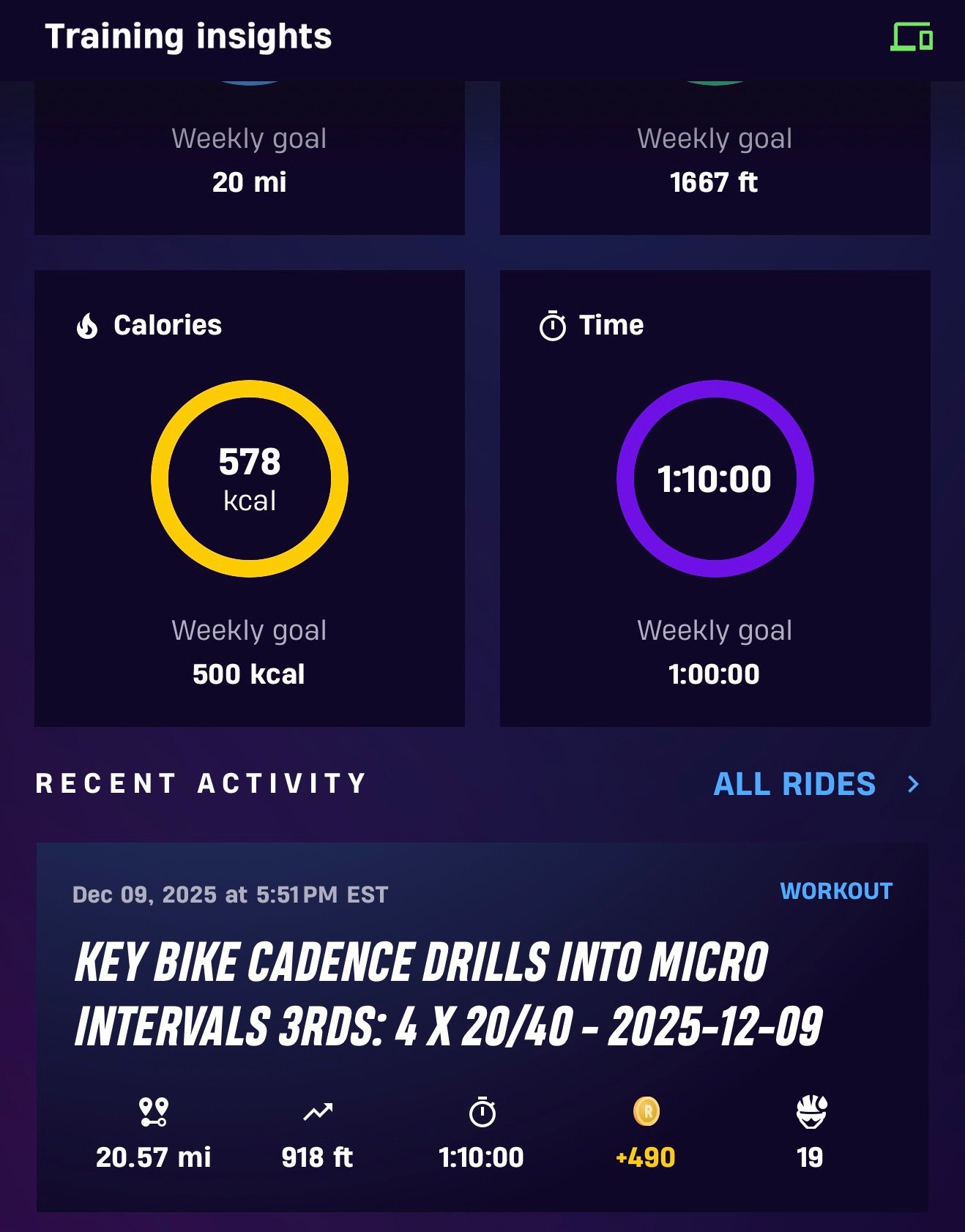
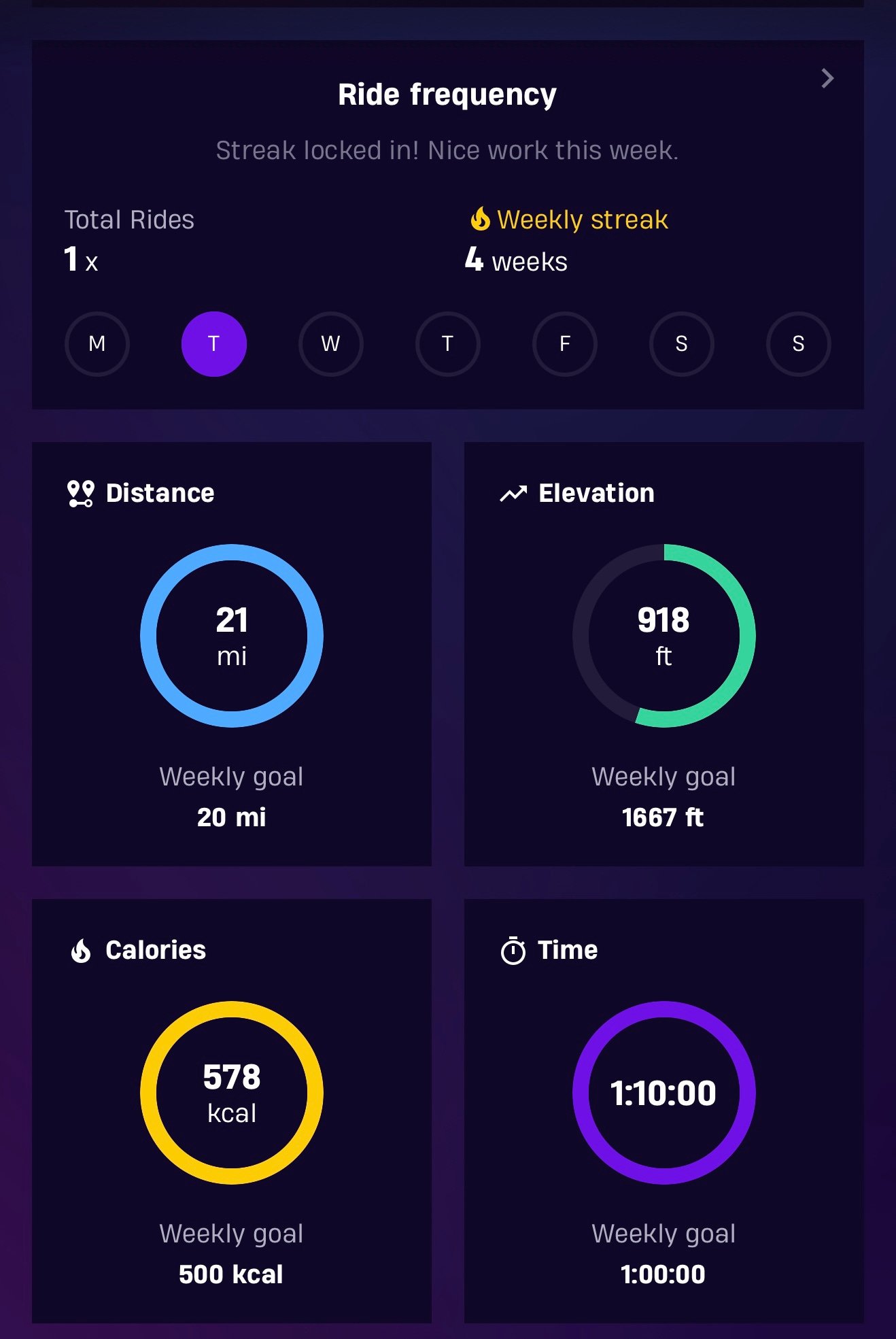
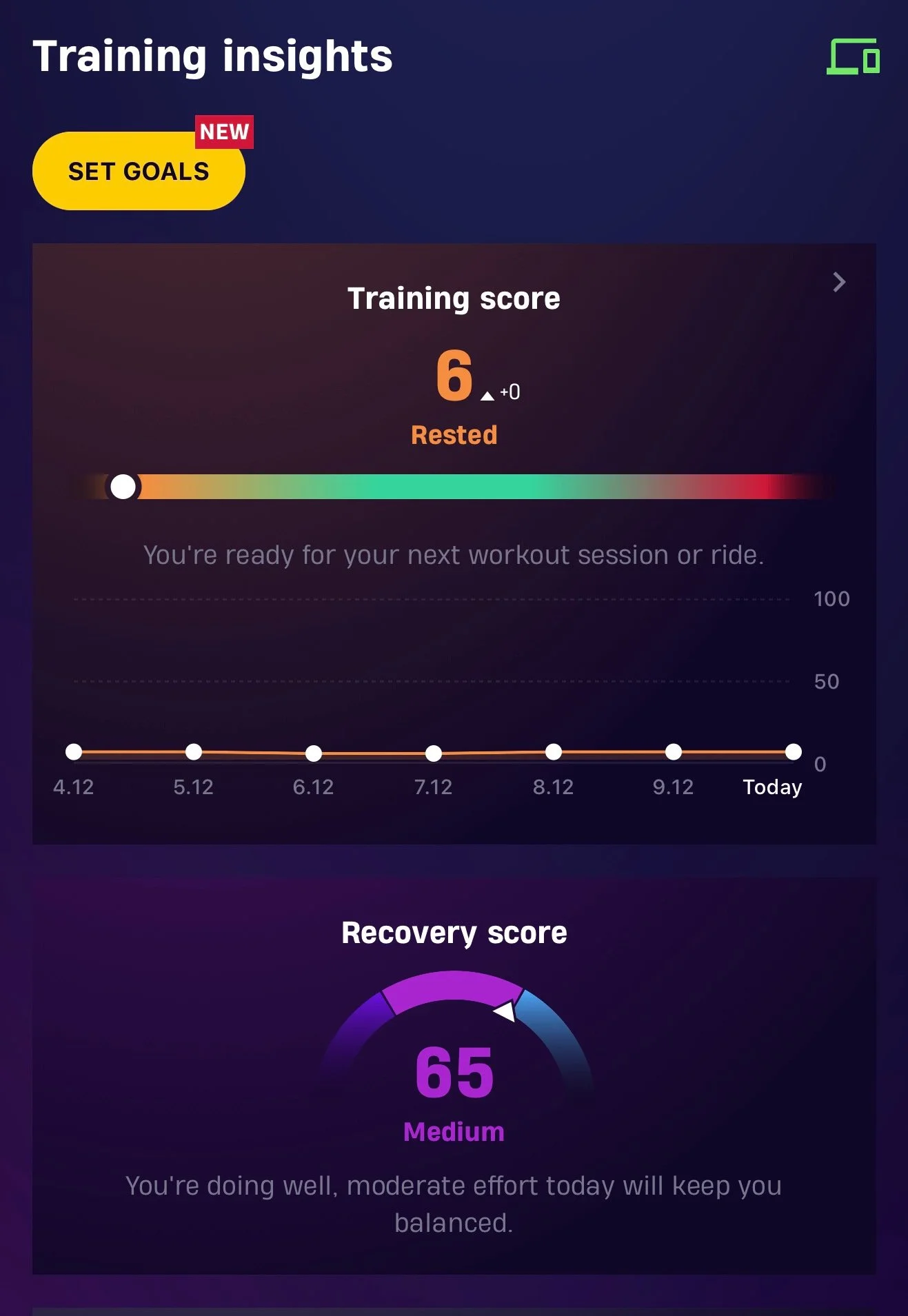
Here’s a few screenshots from the mobile Rouvy app. You can see training metrics, stats, workouts, and challenges.
Cons
There aren’t many cons with Rouvy, that we’ve found, especially now that they’ve added a lot more IRONMAN courses. One piece of feedback is we’d both like some sort of indication that the next segment in your workout is coming up.
There’s plenty of visual feedback with a workout graph at the bottom of the screen and a time reference on the sidebar, but we often find ourselves missing the start of a new segment. Perhaps it’s a result of coming from a platform like Zwift, where you ride through a large gate on screen that indicates the next segment of your workout is starting.
A simple way to do this (and still retain the pared-down visuals) might be to have the current segment in the sidebar flash briefly as it’s about to change to the next segment.
Some people miss the group chat options that are offered on other platforms, but honestly I don’t have time to type messages while riding my bike! And conversations between other folks don’t randomly pop up on my screen while I’m riding, which I appreciate.
What does Rouvy cost?
Rouvy has a few different subscriptions to choose from, all of which include a 7-day free trial. There are monthly and yearly prices, as well as a bundled option for multiple accounts.
A single subscription is $15 a month billed yearly, or $19.99 per month
A double subscription for 2 accounts is $20.83 a month billed yearly, or $29.99 a month
A group subscription for up to 5 accounts is $41.67 a month billed yearly, or $59.99 a month
But, because you’re a subscriber of the Triple Threat Life newsletter, you get one month on Rouvy for free! All you have to do is use the code: BRITTANY1M when setting up your account.
Coming up next week, you can even ride with my coach, Marni Sumbal! (22 x IRONMAN, 5 x Kona, 3 x XTRI, Norseman finisher, 70.3 Louisville and IM Chattanooga OAF) There will be a ride December 16th at 6:30 pm EST (Zone 2) and December 18th at 6:00 am EST (Challenge).
Also, a neat feature is that Rouvy allows you to pause your subscription for up to 180 days, once per calendar year. They also have a Loyalty Program, if you’ve been riding on Rouvy for more than 65 days, where you can get between a 15% to 24% discount on your annual subscription. There’s even a referral program where you can offer a discount to your friends and receive a credit to your account each time someone uses your link.
We’ve really enjoyed using it so far (I think Matt wants to fully switch from our other platform…) and are excited to ride on some of the courses we plan to race at in the 2026 season.
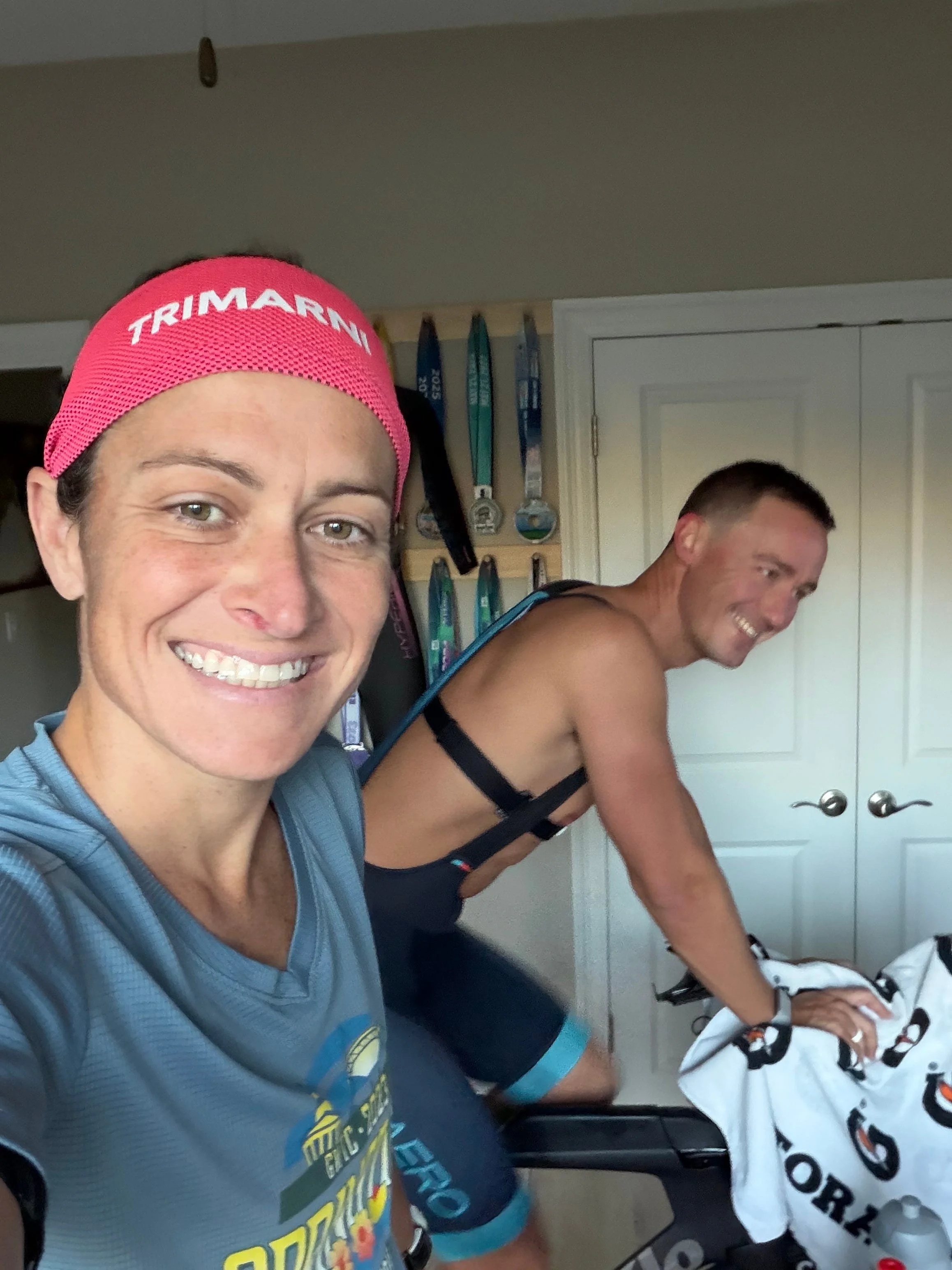
Indoor cycling with our littler helpers!


Join the Triple Threat Life Club
What does Club membership include?
Access to monthly expert webinars + video replay
Bonus members-only articles, guides, and video tutorials
Over a dozen discounts to premium brands you can’t get anywhere else
Discounts on all e-books and future titles
FREE Triathlon Foundations e-book