

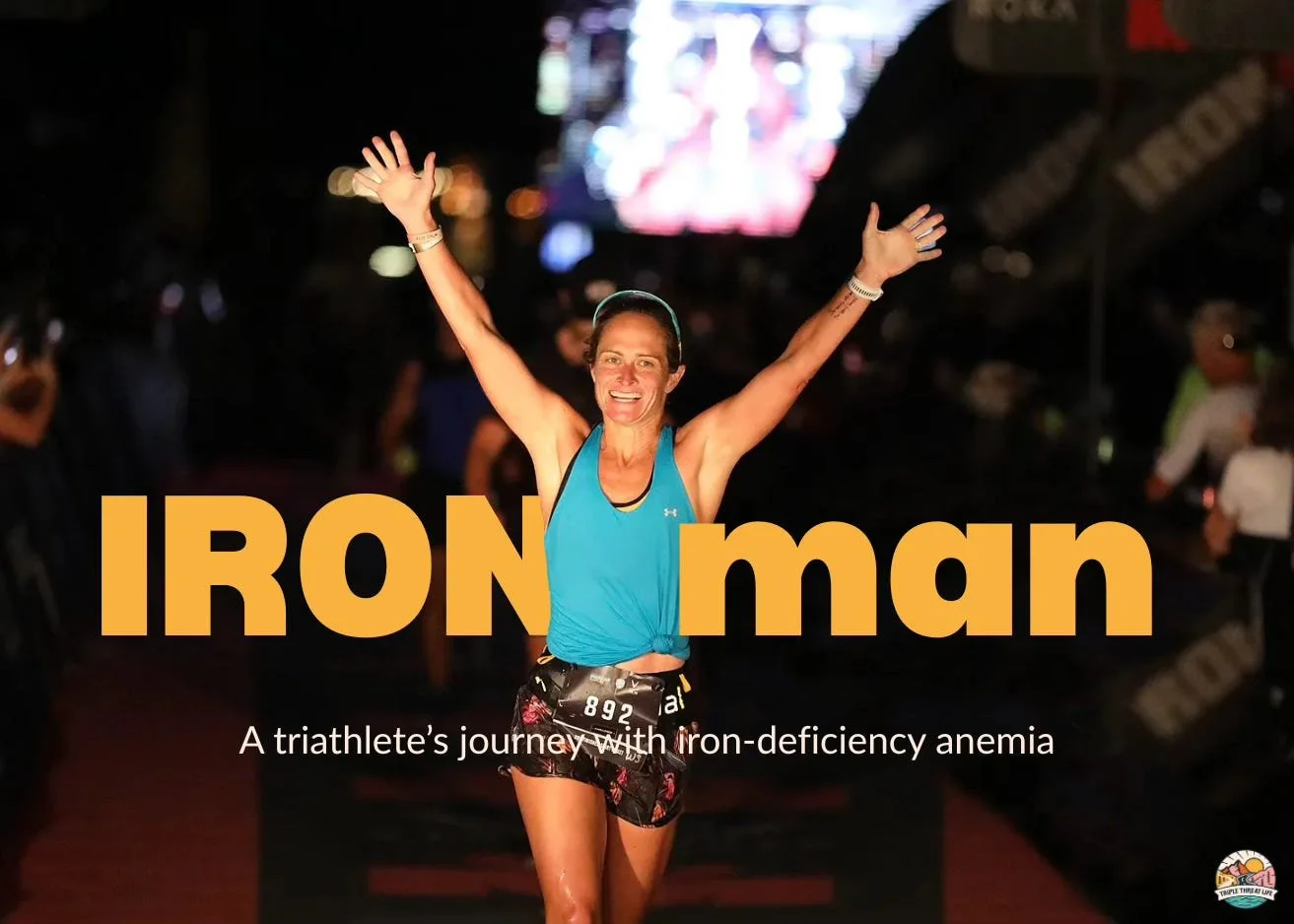
IRONman: A Triathlete With Iron Deficiency Anemia
Learn more about 70.3 and Ironman triathlon prep with our complete guide here.
I started running in the summer of 2018.
But despite being a relatively fit human being, I struggled, A LOT.
Some of that’s expected as a new runner, but this was different. I felt like I couldn’t catch my breath, I was fatigued, and I had no energy. Some mornings, it felt like I could barely open my eyes and get out of bed.
And I craved eating ice… (weird, right?) A chance encounter with a running coach helped me discover the culprit.
I had iron deficiency anemia.
What’s iron deficiency anemia?
Iron is a mineral that the body needs to produce hemoglobin, which is a substance that allows our blood cells to carry oxygen. The body doesn’t naturally produce iron, so we have to get it from our diet or through supplementation.
Iron also helps to create the body’s main energy source, ATP. So you can imagine why it’s so essential for runners and endurance athletes.
Iron deficiency anemia happens when the body doesn’t have enough iron to produce hemoglobin. Now, people can have low iron levels (iron deficiency) without being anemic, which is a more severe condition.
I was severely anemic, and I had no idea until I started running.
Symptoms of iron deficiency
I think one of the reasons why iron deficiency is often overlooked is because a lot of the symptoms are vague and can relate to other conditions. General symptoms include:
Fatigue
Headache and dizziness
Cold hands and feet
Pale skin
Nausea or poor appetite
Unusual cravings for things like ice, clay, or dirt
For athletes, symptoms can also include:
Shortness of breath during exercise
Lack of energy
Exhaustion
Reduction in VO2 max
The diagnosis
Every year, when I visited my doctor, I got a regular blood test. But, she never mentioned anything about my iron levels. I assumed something like that would be included with regular testing, but it’s not.
Perhaps she didn’t have a reason to check it, because I was a pretty fit and healthy human being. I played sports my entire life, but nothing quite as cardiovascularly challenging as running.
One night, a running coach came to speak to our triathlon club. Iron wasn’t even the subject of his talk, but it was an off-hand comment he made that caught my attention.
“When I have a young athlete who isn’t performing to her potential, I have her iron levels checked.”
So, at my next doctor’s appointment, I asked her to run a CBC (complete blood count). The results were shocking.
The number that will always stand out in my mind is 4. My ferritin number was 4.
Ferritin is a transport protein that binds to iron, so it’s a great marker to look at when analyzing iron levels. The tricky thing is that there isn’t a clearly defined range for what constitutes “low ferritin.”
Mayo Clinic guidelines say the normal range for women is 11-307 micrograms per liter, which is a huge range. Still, mine was 4, so obviously not great.
The doctor said she was surprised that I was still upright, let alone running. Because my levels were so low, just changing my diet or taking iron supplements wasn’t an option. I needed two rounds of intravenous iron in the hospital.
Causes of iron deficiency
Part of the reason why my doctor ran a complete blood panel is because it’s not enough to know that I had low iron. We needed to figure out why it was happening. For example, if your body can’t absorb iron for some reason, supplementing with more iron won’t help.
Iron deficiency can be caused by a few different things. For women, the biggest culprit is blood loss during menstruation. Other causes might be a colon polyp that causes bleeding or gastrointestinal bleeding from taking over-the-counter pain meds.
Some people have a condition where the body doesn’t absorb iron very well. But the simplest reason is not eating enough iron-rich foods (vegan, vegetarian). For me, there were a few reasons.
I’m a female.
I rarely eat red meat.
I had a heavy period.
I’m an athlete.
I did have an exam to rule out any gastrointestinal bleeding, so the diagnosis was that I wasn’t getting enough iron in my diet, I had a heavy period, and I’m an athlete.
Iron deficiency in endurance athletes
The Mayo Clinic highlights a few groups of people that have an increased risk of iron deficiency: women, infants, vegetarians, and frequent blood donors. But they’re missing one obvious group- athletes!
Endurance athletes, especially females, have been identified as being at risk for developing iron deficiency. Iron deficiency is more well-known these days, but testing iron levels isn’t something that’s typically included on a yearly blood test, unless you ask for it.
In my opinion, it should be included for every female, whether she’s an athlete or not.
For runners specifically, there’s something called foot-stroke hemolysis where a small amount of red blood cells are damaged as they pass through the feet, due to the repetitive pounding caused by running. Don’t worry, it’s not as scary as it sounds.
Plenty of people run ultra-marathons and they’re just fine. (Well, physically speaking…)
But it’s something to keep in mind if you’re a runner or triathlete, because athletes are more prone to iron deficiency than the regular population. If you’re a female endurance athlete, you’ve probably figured out by now that we got the short end of the stick. We have the trifecta of risk factors.
Blood loss from menstruation
More likely to have a diet low in iron
Endurance athlete/runner = foot strike hemolysis
One study of endurance runners identified 82% of female athletes as being iron deficient. Their mean iron intake was 12.5mg a day, which is below the daily recommended value of 14mg.
Treatments for iron deficiency
Treatment for iron deficiency depends on the cause. I was anemic, so in my case, it involved two rounds of intravenous iron that I received in the hospital.
It probably took a good three months before I started noticing a difference in how I felt. Then, in order to maintain my iron levels, I took 325mg of ferrous fumarateevery day.
Now that I have an IUD, my period is very light, so I take one iron pill every other day. Taking iron in either liquid or pill form can have side effects, like stomach upset and constipation, so I did a lot of research to find the right supplement for me.
I take Ferretts’ Iron Supplement and have never had any trouble with my stomach.NOTE: It’s not a good idea to take an iron supplement, unless you’ve had a blood test and your doctor has determined it’s necessary. Too much iron can lead to hemochromatosis, which can be deadly.
It’s also a good idea to eat iron-rich foods. There are two type of iron sources: heme and non-heme. Heme includes meat, poultry, and fish, which account for 25% of the iron we absorb. Non-heme is found in vegetables like spinach, and that’s absorbed at rate of 3-15%.
Iron-rich foods include:
Meat
Poultry
Pork
Seafood
Beans
Dark leafy greens like spinach
Dried fruit like raisins or apricots
Iron fortified cereals, bread, pasta
Peas
Also, I learned that Vitamin C helps retain and increase the absorption of iron, so a glass of OJ with your iron pill is a great idea. Vitamin C is also found in broccoli, grapefruit, strawberries, and tomatoes.
Blood tests once a year
Once a year, my new doctor does a blood test just to ensure that my iron levels stay on track. This is what she includes.
CBC (complete blood count)
Red blood cell count
Hemoglobin
Hematocrit
Platelet count
Total iron
Iron binding capacity
Iron saturation
Ferritin
She’s a marathon runner, Boston qualifier, and former Ironman triathlete, herself, so she understands the importance of monitoring iron levels. Also, my husband is a doctor, so he takes a look at everything as well.
Over the past five years, my iron levels have stayed within the normal range. It’s something we kept a close eye on, due to my high level of training. These days, my running continues to improve each year.
Don’t get me wrong, running is still hard! But the regular hard, not impossible hard.
*Note: This post isn’t a substitute for medical advice. It’s simply an account of my journey with iron-deficiency anemia. I do know a bit more than the average person, because my husband is a doctor. If you take anything away from reading this, I hope it encourages you to ask your doctor to run a CBC yearly, especially if you’re an athlete- female or male, because men can suffer from icon deficiency as well.
If you’re looking for more info, check out this article I wrote in collaboration with Dr. Ted Farrar (Matt’s Sports Medicine Fellowship Director during college!) for Outside Run. Dr. Farrar is also a fellow Ironman triathlete and manages the medical tent at 70.3 Haines City, so if you race there, stop by and say hello!
One Thing Every Female Runner Should Ask Her Doctor
Please share this post with an athlete, or woman, you care about.