

8 Ways Trail Running Has Made Me a Better Triathlon Runner
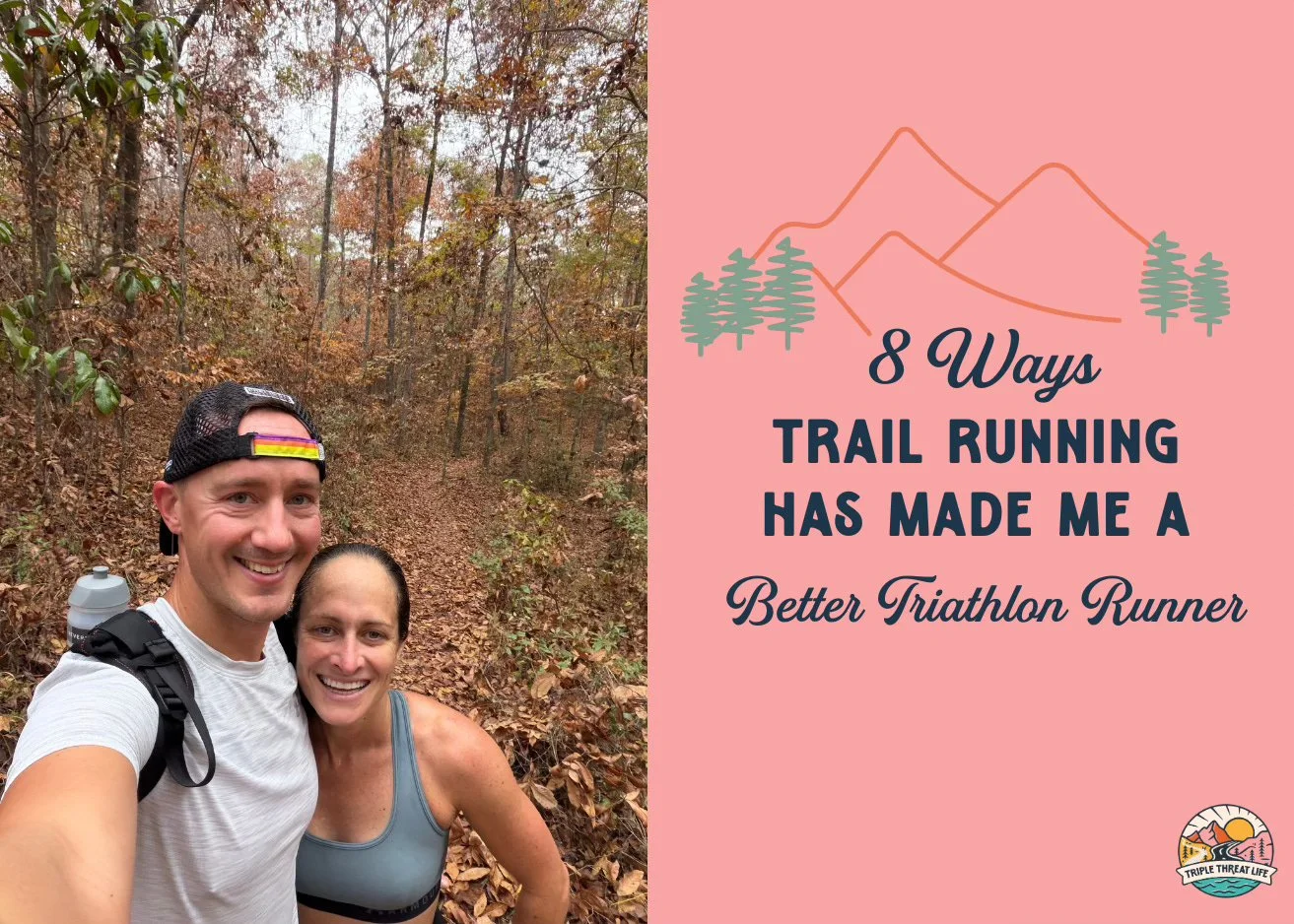
I may race on the road, but I love running trails.
Actually, most people don’t know that my first-ever runs took place off-road.
I connected with a local run group that was doing a summer trail run series. Those were some of my first running races.
At that point, it was more about getting from the start gate to the finish line, since I really had no idea what I was doing. But being in nature, while exercising, and meeting fun, friendly, crazy-people who liked doing the same thing, was the answer to my prayers.
When I first started running in 2018!
It makes sense if you know about my love of the outdoors. Whether it’s hiking on a sun-dappled trail in the forest, riding my bike down canopy oak roads, or running on a rooty trail with twists and turns, I love exploring the great outdoors.
In a past article for XTERRA, I wrote this about trail running:
“Every trail runner has a reason—a spark that gets them out the door and into the wild. For some, it’s about exploration and transformation. For others, it’s about healing, rediscovery, or simply the need to keep moving.
There’s no better way to study the contours of the land than on foot. You feel an almost intimate connection with the high mountains and river-cut valleys when you’ve traversed the terrain under the power of your own two legs.”
And that’s the whole point of trail running, isn’t it? Not necessarily who can get from point A to point B the fastest, but realizing that you’ve covered a distance of the earth solely by the power of your own body.
It’s pretty incredible when you think about it.
But while trail running satisfies my need to get outdoors and feel the warmth of the sun on my face after a long day spent at my laptop, that’s not the only reason why I run trails.
In fact, trail running has made me a better triathlon runner.
Here’s how.
8 ways trail running has made me a better triathlon runner
1. Varied surfaces strengthen muscles, ligaments, and tendons
Running on uneven surfaces strengthens ligaments and tendons in a different way than running on the road.
If you’ve ever run on a particularly technical trail, you know it takes a lot of ankle strength and stability. Learning how to make quick direction changes and maneuver around rocks and hop over roots strengthen your ankles by challenging the surrounding ligaments and tendons.
Also, the softer terrain absorbs more force, providing less energy rebound than the road. Therefore, your muscles have to work harder, in concert with one another, to move you forward. You can imagine what this feels like if you’ve ever tried to run in sand.
And while some trails might be sandy, gravel, dirt, and rocky terrain works in much the same way. Running on softer surfaces strengthens all the small muscles, ligaments, and tendons in your ankles and feet in a way you just don’t get by running on road.
2. Lower impact on joints
This is a big one for runners who rack up a lot of mileage. Doing an easy run on a trail is a great way to give your body a break from the constant pounding of the road. The softer surface is lower impact on your joints and muscles, so it’s a great way to get in the miles you need, while also reducing your risk of overuse injuries.
If I have an easy run on the schedule, I often head out to our favorite trail. I can get in 7+ miles and feel refreshed afterward, instead of drained, which is what an easy run is supposed to do.
3. Improved strength and endurance
Running off-road tends to involve more hills than running on blacktop (even here in Florida!) This makes trail running a great opportunity to build strength and endurance, which is a key component in the long-distance triathlons Matt and I do.
Having the ability to withstand fatigue after swimming 1.2 or 2.4 miles and cycling 56 or 112 miles, is essential when you’re faced with running a half marathon or marathon as the final leg of your race.
A great piece of advice I was given is that it’s not about who runs the fastest, but who slows down the least. The way you do that is by becoming an efficient runner and developing great strength and endurance so you can hold form even in a fatigued state.
4. Great way to keep heart rate low during easy runs
If we have an easy run, I almost always head to the trails. The uneven terrain and obstacles have a way of forcing you to pay attention to your effort, as opposed to maintaining a strict minute per mile pace.
Learning how to control your breathing and heart rate as you climb hills is another benefit of trail running. In fact, over the weekend I had an easy run on hilly terrain. The goal was to control my breathing pattern and heart rate as I climbed hills, which made the trails the perfect choice.
Triple Threat Life is a reader-funded publication, supported entirely by you.
If you’re interested in supporting independent journalism and my mission to provide practical multi-sport knowledge to athletes everywhere, a paid subscription is the best way to do that.
With an annual subscription discount, it’s less than a coffee a month, and it’s what keeps this newsletter going. Click here to upgrade to a paid subscription.
5. Stress relief and clearing the mind
Being in nature, and away from technology, is a great way to relieve stress and clear your mind. For me, being outdoors provides a mental reset and helps to change my perspective.
Suddenly, the things you thought were so important somehow don’t feel quite as big when you’re face-to-face with the immensity of God’s creation. Running in the quiet of the forest brings with it a peace and solitude that’s rare to find in today’s world.
So, if you run trails, I would encourage you to run without music and seek the sounds of the wind rustling through the trees, the birds chirping, the crunch of gravel underfoot, and the sounds of your own breathing.
You never know what you will find on the trails!
6. Let the metrics go and learn to run by feel
I’ve written in the past about the importance of learning how to run by feel, and trail running is a great way to develop that skill. Running on unfamiliar terrain encourages you to abandon rigid adherence to the “I have to run X pace” mentality.
Becoming a better runner is all about becoming more in tune with your effort level, regardless of what the numbers say on your watch. When I go for a trail run, I wear a watch, but I don’t look at it. The device is there to record data, not to govern my effort.
If you need something to look at, make a screen that only shows time, miles, and heart rate.
By learning to run by feel, when I get to a race, I don’t need to check my watch repeatedly to see if I’m running at a goal pace or if my heart rate is too high. I know already before I even look, because I’ve developed the ability to judge my effort level by feel.
7. Improved durability and efficiency
I used to think that running fast off the bike was my main goal in a triathlon. Over the past year, I’ve learned that I was wrong.
My coach has helped teach me that I don’t necessarily need to become a faster runner. I need to become a more durable and efficient runner.
Running on the uneven surface of trails improves core engagement, a key component in efficient running. Maneuvering around roots and rocks helps improve balance, agility, and proprioception.
When you run on the same surface all the time, it’s easy for your muscles to fall into a monotonous pattern of firing the same way over and over again. Trail running provides a new stimulus, which challenges your body in a different way. This helps you become stronger, more durable, and efficient, which helps you get…
You guessed it- faster.
8. Promotes a naturally higher cadence
I’ve always had a relatively higher cadence, and it’s something I attribute to trail running. I’m not at elite-level cadence by any means, but by learning how to hop, twist, and turn on technical trails, I’ve developed the ability to run at an efficient cadence.
Think of a swift bunny bounding over hill and dale, as opposed to a plodding elephant. Higher cadence means less wasted effort. Your energy doesn’t get absorbed into the ground; it moves you forward.
Running on trails also encourages you to pick up your feet. No shuffle and plodding here! Or else you risk falling face first into a bed of poison ivy. (Actually did that at a trail race once. Not fun. Wouldn’t recommend).
If you enjoyed this post, here’s what you can do. Subscribe to get the newsletter delivered to your inbox weekly. Share with a friend. Upgrade to a paid subscription to support my work. Thank you for reading!