

Debunking 6 Common Myths About the Triathlon Swim
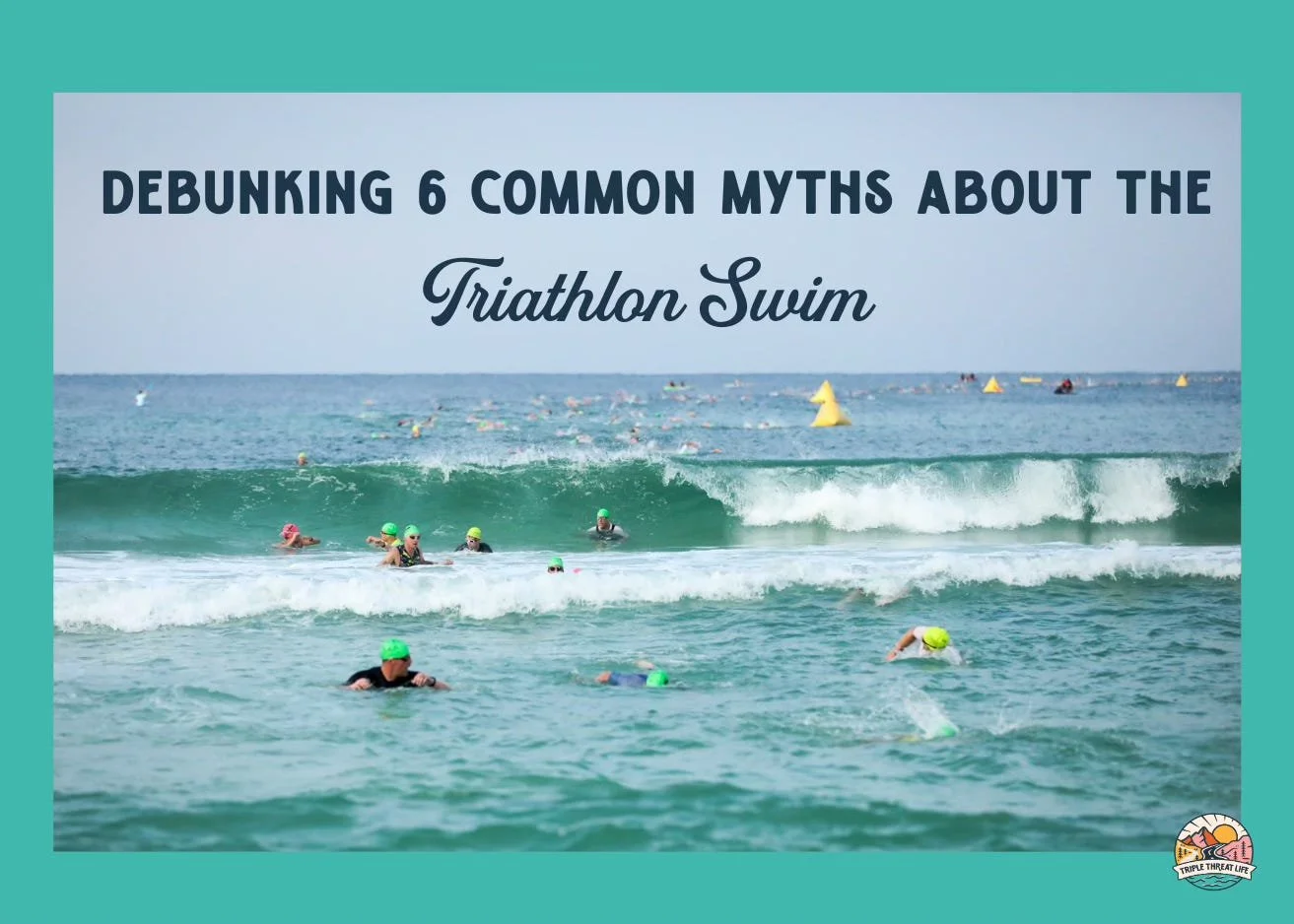
For more on open water swimming, check out our beginner guide here.
Let’s face it. Swimming (in open water in particular) is the biggest barrier to entry for triathlon.
If I had a dollar for every time someone told me- “I would totally do an Ironman, if I didn’t have to swim…” I would be a very rich person indeed.
The thing is that 80-90% of age group triathletes are adult-onset swimmers. Sure, we might have splashed around in the pool as a kid, but we didn’t grow up knowing how to swim a proper freestyle. And most of us weren’t on a competitive swim team.
Therefore, the first time we learn how to swim laps in a pool, with some semblance of form and technique, is in our 20s, 30s, 40s, or 50s. In fact, many people won’t learn how to swim until they sign up for their first triathlon.
Raise your hand if this is you.
The good news is that thousands of people, just like you, have learned how to swim well enough to complete a sprint or Olympic distance triathlon and even the 1.2-mile swim of a 70.3 and the 2.4-mile swim of an Ironman. Although it might seem intimidating at first, I’m here to tell you that it’s 100% possible, because I was once in the exact same position you are.
But there’s a catch.
You have to be willing to put in the work. You have to patient. You have to be a good student.
If you don’t have a triathlon coach who’s writing workouts for you, providing video instruction, and critiquing your form, it can be hard to make any real progress. Then, you start searching videos on YouTube or social media and get a million different pieces of conflicting advice from a million different “experts.” It can be SO confusing.
In an upcoming post, we’ll talk about simplifying the triathlon swim. We’ll cover the basic skills you should learn, essential drills to improve form, how to breathe properly, and how to become more confident in the water.
But today, I want to start by debunking 6 common myths about the triathlon swim.
6 common myths about the triathlon swim
1. You don’t need to spend as much time working on the swim, because the bike and run are where bigger gains can be made.
This is my favorite myth, because it’s something that even veteran triathletes get wrong. Typically, the argument is that the amount of time you spend in the swim is a lower percentage as compared to the bike and run.
That part is true.
Sprint Triathlon: (750m) The swim is 15-20% of the total time.
Olympic Triathlon: (1.5K) The swim is 15-20% of the total time.
70.3 Triathlon: (1.2 miles) The swim is 10-15% of the total time.
Ironman Triathlon: (2.4 miles) The swim is 5-8% of the total time.
Therefore, the swim isn’t as important as the bike or run.
That is a lie.
You can’t think about a triathlon (of any distance) in segments. Each discipline builds upon the next and will have an effect on your energy level, fatigue, and endurance.
Here’s the bottom line: You can’t bike to your potential if you’ve exhausted yourself during the swim, because you didn’t train for it properly. You can’t run to your potential if you’ve used up all your energy on the bike, because you came out of the swim exhausted.
Although the swim takes up less total time than the other two disciplines, if you can’t swim efficiently, it will inhibit your ability to bike and run as well as you could. In fact, many athletes focus so much on increased bike volume or track sessions thinking they need to get faster at cycling or running, when in reality, they need to show up to the bike and run feeling fresher. That starts in the swim.
2. You don’t need to practice swimming in wetsuit, because it makes swimming easier.
Does wearing a wetsuit make swimming feel easier? For most of us, that’s a yes. A wetsuit provides added buoyancy, helps you glide through the water with greater ease, and gives less confident swimmers a mental boost. But a wetsuit isn’t a crutch to be used to make up for bad form or neglecting swim training.
Also, swimming in a wetsuit is a skill that must be learned prior to race day. You need to get used to the feeling of slight chest compression that can contribute to open water anxiety. If you’re using a sleeved wetsuit (and let’s face it, why wouldn’t you?) you need to get used to how your shoulders will feel while swimming with tight neoprene stretched over them.
You can practice swimming in a wetsuit in the pool. Typically, pools aren’t cold enough to justify swimming long distances in a wetsuit, but you can certainly do a couple 100s to get used to the feeling. Then, ideally you should practice in your wetsuit in open water.
Please do not let your first open water swim (or the first time using your wetsuit) be on race day. That’s a very bad idea.
3. You need to practice “swimming the distance.”
This is a very common mistake among new triathletes, and I completely understand why. I see this happen across all distances of triathlon, but especially when the swim is long, like the 1.2-mile swim of a 70.3 or the 2.4-mile swim of an Ironman.
You think- “I need to get used to swimming the distance without stopping, because I can’t stop during the race.”
So, you see people swimming laps in the pool without ever stopping… 1,000y, 1,500y, 2,000y at a time.
This is a great way to get really good at swimming poorly.
By swimming without ever stopping, all you’re doing is exhausting yourself, and you probably didn’t have that great of form to begin with. So, as you swim, you get more and more tired, your form gets worse, and you swim slower and slower. You never see improvement and you get frustrated.
A proper swim workout will include smaller intervals with a rest period on the wall. For example, you might swim 6 x 50y with 15 seconds of rest. You might swim 3 x 100y with 20 seconds of rest. You might do 20 x 25s with 10 seconds of rest.
Breaking your swim into smaller intervals (50s, 75s, 100s, 200s) is a great way to work on swimming at different intensities, while maintaining good form, which improves swim fitness. You must learn how to hold good form and technique at shorter distances first, in order to become more efficient in the water. That efficiency will carry over into endurance, which is what gets you through those 1.2-mile and 2.4-mile swims.
4. In order to improve in swimming, you need to swim fast/with intensity all the time.
I see a lot of triathletes doing these intense swim sets, with little rest, and their sole focus is on swimming hard and fast. I mean, that’s the only way you get faster at swimming is to swim fast, right?
Not necessarily. While swimming at different intensities is an important part of building swim fitness, so is working on form and technique. This involves many components: good head position (neck long, eyes looking slightly forward), taut body alignment (strong core), controlled breathing pattern, catch (what propels your body through the water), and kick (just enough for balance).
Sometimes, the way you get faster at swimming is by slowing down. It’s important to include drills in each swim workout, with purpose and intention. Is today’s session focused on body position? Catch? Breathing?
You might be surprised to learn that 1/3 to 1/2 of our swim sets consist of drills! You can incorporate a few drills into your warm-up to realign your body position and establish a good catch before you get to the main set.
Sometimes, the main set even includes some drills, which can be used as active recovery between harder intervals. Finally, we might do a few drills during our cool-down, like kicking in streamline on our back or using a front snorkel.
It’s not just intensity or just drills. You need both.
5. Triathletes don’t need to kick to save their legs for the bike and run.
More bad advice. This just isn’t true. But, often, I find that new swimmers do the exact opposite. They kick like a motorboat, thinking that’s what will propel them through the water. If you were going to the Olympics to swim 50y as fast as humanly possible, that might be true, but you’re not.
In reality, the catch is what provides most of your propulsion through the water. But because most of us haven’t developed a good catch and feel for the water, we overcompensate by kicking too much. Over-kicking wastes energy and will slow you down in the long term.
So, let’s not kick at all! Nope, that’s bad too. You do need to kick some, because that’s what helps you stay balanced in the water. You can’t separate the swim stroke into just arms or just legs. It’s all interconnected. You need good rhythm, catch, pull, and glide with a taut body line, engaged core, and yes, you need to kick.
6. You should learn how to flip turn or else you look like a newbie.
This is a big pet peeve of mine. I’m sorry, when did swimming (or triathlon for that matter) become a judged sport? Also, why do you care what anyone else thinks about your workout in the first place?
If you want to spend a few hours perfecting your flip turn, go ahead. But most athletes would be better served if they focused on things that will actually help them swim better. Bottom line: Is having the ability to flip turn a fun skill? Yes. Is it essential for triathlon? No.
Also, if you’re flip turning anywhere on an Ironman course, something has gone terribly wrong. So, if you like flip turns, do them. If you don’t like flip turns, don’t stress about it.
BONUS- You don't need to fuel swim workouts, because you won’t get to drink during an Ironman.
I actually saw a post (from a swim coach) about this the other day. Le sigh...
Are you expending energy during the swim? Yes. Are you sweating in the water while you swim? Also, yes. Therefore, you need to fuel the swim. Plain and simple.
It isn’t a big deal. Just have a water bottle on deck with 30g of carbs and electrolytes and take a few sips during breaks. Done.
But prohibiting or advising athletes against drinking on deck, because “your body needs to learn how to swim without fuel” is moronic.
The fact is that most triathletes (especially those training for 70.3 or Ironman) are doing two-a-days- ie. more than one workout a day. Therefore, you must take every opportunity to stay ahead of fueling to ensure you can complete your workouts to the best of your ability and recover well, so you can get stronger, faster, etc. This includes pre-workout nutrition, workout nutrition, and post-workout nutrition.
Am I not fueling my 3,000y swim and then doing a 7-mile run after? I don’t think so.
Have a drink on deck.
If you want to learn more about the triathlon swim, check out this posts.