

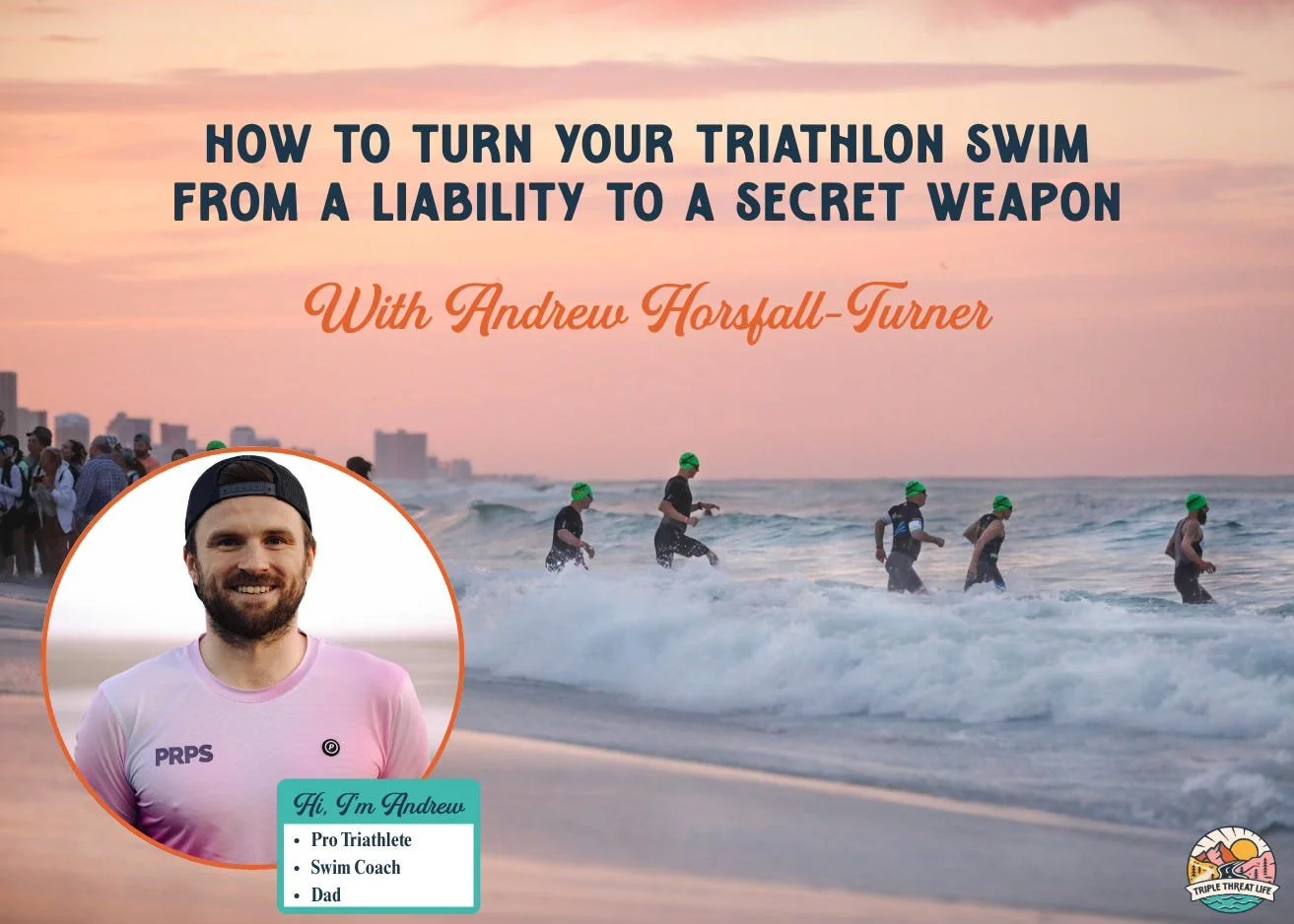
How to Turn Your Triathlon Swim From a Liability to a Secret Weapon with Pro Andrew Horsfall-Turner
For a complete guide to open water swimming, check out our beginner guide here.
Whether you’re an age-grouper, or a professional, none of us start out as triathletes.
We’re either drawn to the sport as an injured runner seeking cross-training, a former swimmer looking for a new competitive outlet, or a cyclist… (who wants more suffering, I suppose?)
Like many of us, professional triathlete, Andrew Horsfall-Turner, came to the sport through a somewhat circuitous route. With a childhood deeply entrenched in swim club, he didn’t even know what Ironman was, until much later in life.
“It was 2017, and I’d finished my collegiate swim career, so I was coaching swimming. My dad did a race in the UK called Outlaw Triathlon to celebrate his 50th birthday. I want to say he did it in 13 and a half hours. I remember thinking that my dad was absolutely crazy. I thought it was absolutely nuts. Then, two years later, I was doing one,” Andrew says.
Andrew did his first Ironman as an age-grouper at Ironman Wales. Since 2018, he’s gone from age-grouper to pro and now races against the best in the world over Ironman and 70.3 distances. In a fun turn of events, in 2021, he set the Welsh iron-distance record of 8:26:27 at Outlaw Triathlon, that same race he watched his father do a few years prior.
It planted the seed…
Andrew grew up in the pool. By the time he was six, Andrew joined a swimming club. As he got older, he specialized in “all the hard events, because I wasn’t naturally quick.” He swam 200 butterfly, 400 IM, and 500 freestyle. That led him to becoming a distance swimmer.
After swimming at international competitions and graduating with a sport science degree from Swansea University, he wasn’t exactly sure what he wanted to do with his life.
“I thought I’ve spent so many years swimming, why not get into the coaching side of things? Luckily, as I was finishing university, one of the coaches said I should give it a go. They invited me back the following year,” he says.
Originally from Sussex, England, Andrew has lived in Swansea in South Wales since 2012. Because he grew up as a swimmer, he says he was “sheltered to the whole world of triathlon.” But little did he know that Ironman was right on his doorstep.
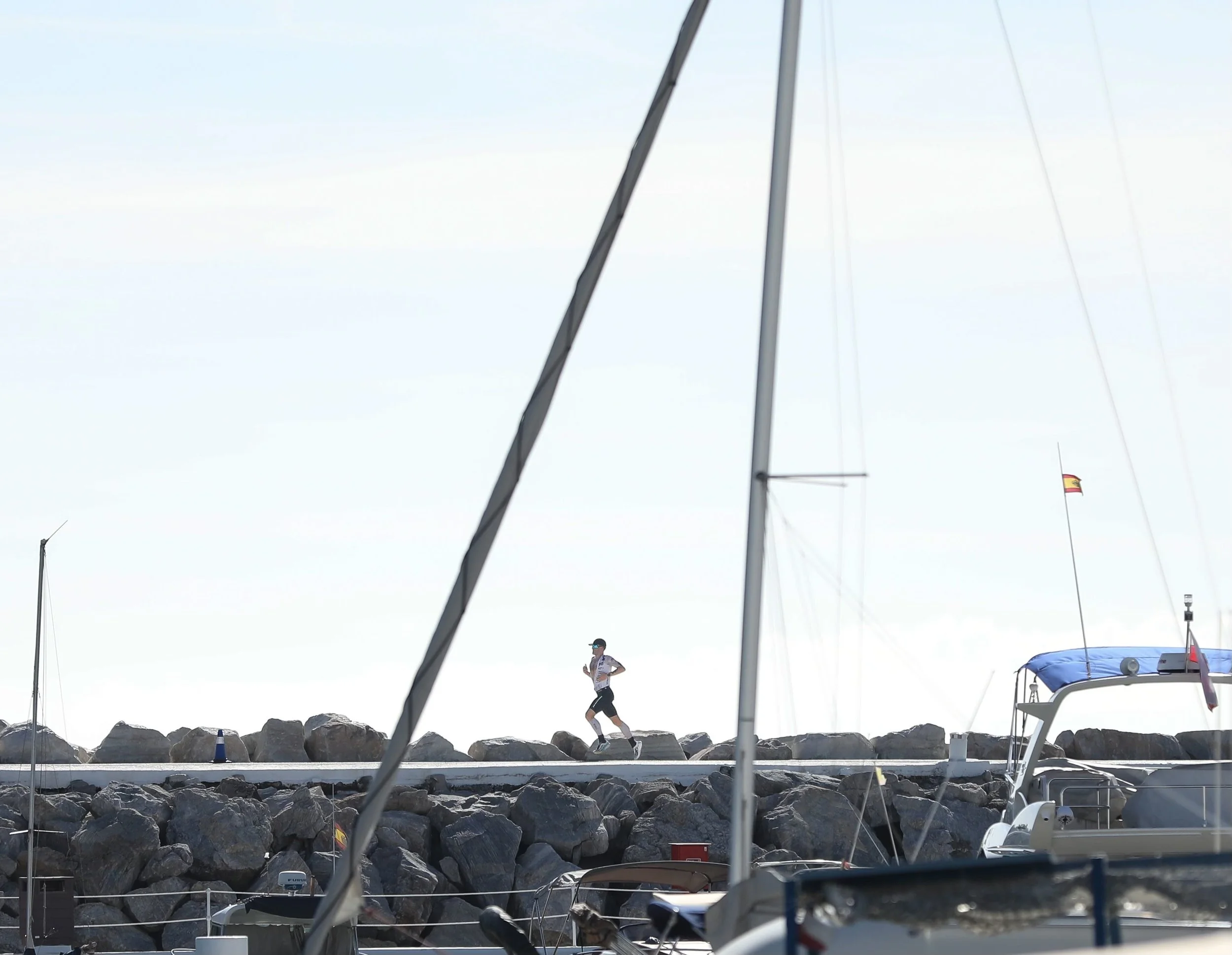
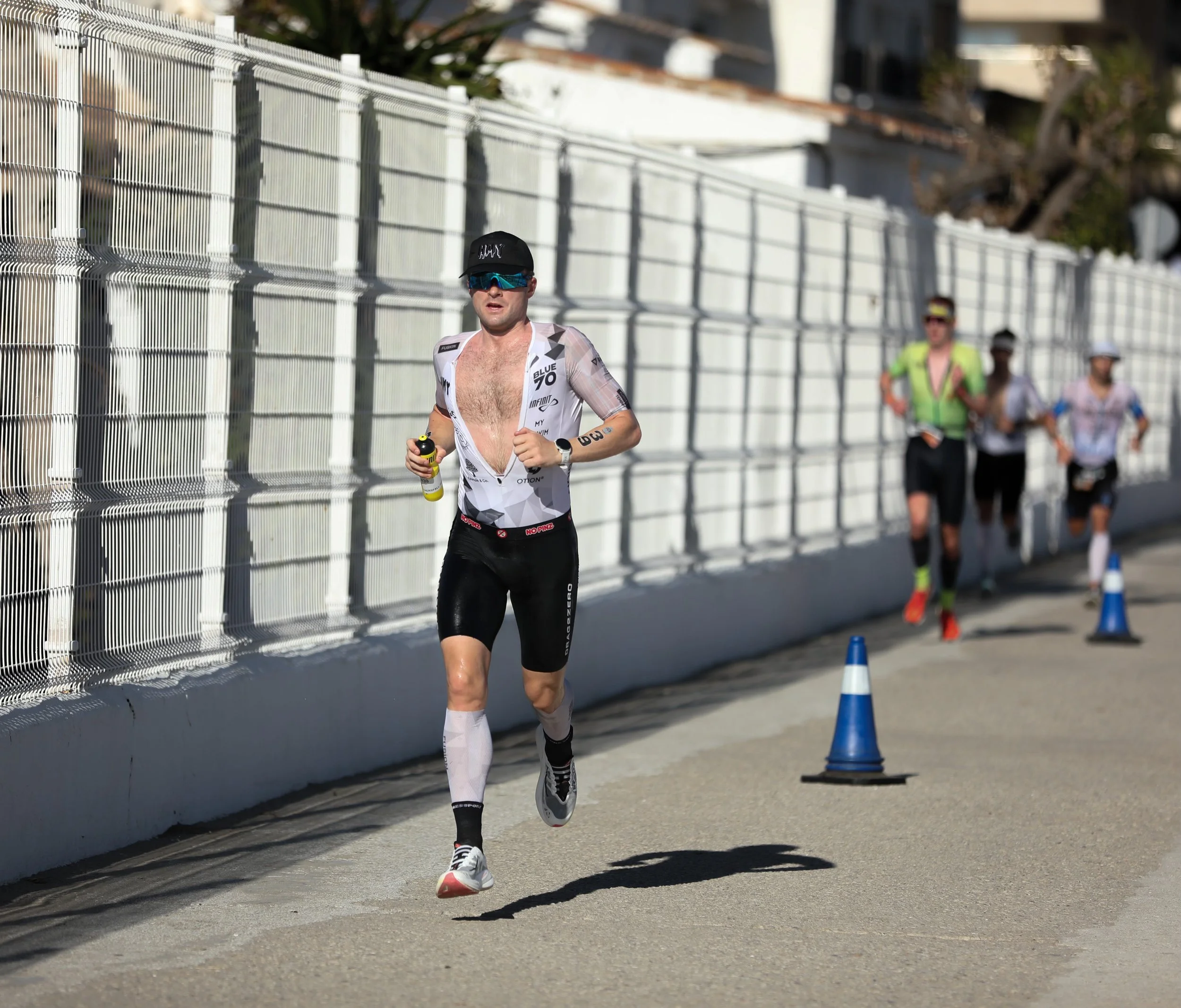
Andrew competing at the 2025 Ironman 70.3 World Championship in Marbella, Spain. Photo: Brittany Vermeer/Triple Threat Life
His first introduction to the sport came at Tenby, the home of Ironman Wales, during an event called Long Course Weekend. It consists of an Ironman distance swim on Friday night, an Ironman distance bike on Saturday, and a marathon on Sunday.
“They put prize money on each discipline, so each year a few of the swimmers from university would go down and try to win the prize,” he says. “It was a really cool race, because it’s literally swimming on the Ironman swim course. But I still didn’t quite understand the kind of the scale and size of what IRONMAN really was.”
After watching his dad do the Outlaw Triathlon in 2017, Andrew decided it was time to give it a go. He raced Ironman Wales in 2019 and qualified for Kona as an age-grouper, although Covid prevented him from being able to attend that year.
“Since I was an elite-ish kind of swimmer, I definitely had this itch that I wanted to maybe race professional. I had this feeling that I could be good enough, because I was always good at the longer swim races,” he says.
Andrew raced the Outlaw Triathlon in 2021, which is a gateway race in the UK. That means the prize is a pro card for the next year. “So, I went there with that target, and I was lucky enough to break the course record. It was crazy, because I was an amateur at the time, but because I broke the course record, I got prize money.”
“It was my first taste of getting a paycheck for being a triathlete. It was a breakthrough in the sense that I got a pro card for the following year, but also maybe the confidence to pursue the sport a little bit more as well.”
Another seed was planted…
These days, Andrew races 70.3 and Ironman as a professional triathlete, in addition to coaching triathlon and swimming with My Swim Co in Swansea. It’s a company that specializes in teaching adult-onset swimmers, so that’s what Andrew is here to help us with today!
Q&A with Andrew Horsfall-Turner
Why do you think so many age-groupers struggle with the swimming portion of a triathlon?
“Unfortunately, I think a lot of it stems from poor swimming education growing up. We teach a lot of adult-onset swimmers who come to us without the ability to swim a length of front crawl. And they say, ‘Oh, by the way, I’ve entered an Ironman in five months time.’ So, the challenge is there in front of us.”
“There’s no guarantee in 20, 30, 40 years time that your kid will become a triathlete, but the best gift you can give to a kid is the ability to swim. I would implore everyone to make sure their kids have the basic badges, in terms of being able to swim a length of front crawl and water safety as well.”
*A video replay of the Monthly Expert Webinar with Andrew is now available for paid subscribers in the Expert Interview Archive.
There’s so much information out there about swimming. How can we make the triathlon swim less complicated?
“With a lot of new swimmers, the biggest issue I see is confidence. So, I strip everything way back to getting someone very comfortable floating in the water. So, floating on your front, floating on your back, rotating from your front to your back, things like that. Also, we want to get people super comfortable with having their face fully submerged in water. That’s a big thing. Most people can do the semi-swim with head-up breaststroke thing, but they don’t have the confidence to put their head in the water. Then, obviously in open water that becomes even more difficult.”
“One of my favorite drills for new swimmers is side-kicking. It can be done with or without fins. So, you’ve got one arm out in front and you kick on your side, while turning your head to take a breath and then put your head back down.”
“If you can get people super confident doing that, then the swimming part of it is actually very simple. If you’re confident putting an arm out, extending it, lying on your side and taking a long breath, then you can take a couple of strokes and do that again. It doesn’t matter if there’s a pause in the stroke, and it doesn’t look pretty or efficient. As long as they’re not getting out of breath and able to repeat the motion again and again and again over a duration of months, etc., they will become much more proficient, even if they don’t have any further swim coaching after that.”
“There are other drills that might be flashy, but do they actually have a purpose? I would rather do the simple drills a million times and do them really well, than do a fancy drill that 99.9% of people probably can’t do.”
Speaking of drills, what’s another one of your favorites?
“My favorite drill is called Torpedo Drill, or head-led rotational drill. Basically, you put your arms by your side and lie flat in the water. Then, you push off and kick on your tummy. You’re focusing on having really good posture through the body and alignment with a straight line from the middle of your head all the way down to your toes. Then, there’s also the balance of trying to stay as flat as you can in the water.
Then, you just kick on your front. That’s the first step. The second step is adding rotation. So, you keep your head nice and still, looking at the floor. Then, you rotate your hips and your shoulders 90 degrees and then back onto your tummy.
There’s a lot of ways you can do it. You can use fins. You can use a snorkel. For those who really struggle with the buoyancy element, you can utilize a pool buoy in various places- between the legs, between the knees.
You’re not doing anything with your arms. All you’re focusing on is being able to balance your body without using your arms.”
A lot of people who are new to the sport come in with the goal of doing a 70.3 or Ironman. So, they’re facing a 1.2-mile or 2.4-mile swim, which is very daunting as a brand-new swimmer. A big misconception I see is people thinking they need to learn to “cover the distance,” so they swim continuously without stopping. Can you explain why this is not an effective way to build endurance, as well as the benefit of using shorter intervals like 25y, 50y, 100y?
“I think the biggest issue with swimming is the ability to maintain (for lack of a better term) a correct stroke. If you’re trying to become a better, more efficient swimmer, then going to the pool and swimming 1,000 or 1,500 meters at a time, unless you’re a very good level swimmer already and able to maintain your stroke efficiency, your stroke rate, the intensity you want to swim at, there’s very little you’re doing to help yourself.”
I know people like it for a confidence thing, and that’s not something I’m against necessarily- either by doing a broken distance or even open water swimming the distance. But if you’re trying to build up to that level, 100 meter reps are golden. They’re the perfect distance.
Also, do you know how many strokes you take in a length? Can you swim and maintain that stroke rate? Let’s say you take 25 strokes in a length. If you can make a couple of skill adjustments and then all of a sudden you’re swimming 20 strokes a length, add that up over a 70.3 distance or an Ironman distance, and how many strokes have you saved?
Then, once you become fitter, you can continue to do short reps- 50s, 100s, 200s, but just reduce the amount of rest. So, you might start off by taking 60 seconds of rest after 100m. Then, over time you might get to the point where you only need five seconds, and five seconds is enough for you to mentally reset for another rep.
I’d much rather see someone do 10 x 100s, rather than do 1,000m straight and it be rubbish.”
Take us into your training as a pro triathlete for a moment and explain one of your favorite swim sets.
“It’s nothing too exciting. My favorite set is basically blocks. So, I do a 400m, 300m, 200m, and 100m. I would probably do that three times through. What I try to do is reduce the interval each round. So, the first round is conversational, steady, easy, and the next round will feel a bit more like a tempo effort. Then, the last round is what I always feel is a bit thresholdy. Especially for like a 70.3, that’s almost race intensity at a pro level.
I know that based off previous times of doing the session, that if I’m doing the final round off a 1:15 base, that I’m swimming pretty well. Because obviously, you’ve got to swim the 400m quicker than five minutes, and then whatever you’ve got left over is my rest. So, it’s 1:15 based the whole way through. So, it’s five minutes, 3:45, 2:30, and 1:15. So the quicker you swim, the more rest you get.
For most people getting into swimming, I think it’s much more sensible to go off a specific recovery time, because you want to make sure you’re getting enough rest. The more experience you get, you understand what time you swim a 100m, and you can go off a set interval.
Also, swimming based off intensities is helpful. But, obviously if you’re new to a sport, your range from easy to hard will kind of be the same thing. If you’re already completely out of breath after a length or two, then there’s no real difference between going hard and going easy, because it’s the same thing. Then, over time, you might have easy, medium, and hard. It just takes time.”
We always get questions about how often triathletes should swim and for how long. I would imagine it’s different for pros and age-groupers?
“Most weeks, I’m swimming four to five times a week. But when I first made the transfer from being a swimmer to triathlete, I was swimming six days a week, because it’s what I knew. As I’ve become a more well-rounded athlete over time, it’s reduced.
And I know there’s a time demand for getting to the pool, getting changed, getting in the water, and getting home. But I’m always a big fan of swimming more regularly instead of longer. So, if you can swim three times a week and do 2,000m a session, then you’re doing six kilometers a week. I’d much rather see someone do those three sessions rather than two sessions and have it be three kilometers a piece. So, I favor frequency over duration, basically. And even if all you have time for is 20 minutes and you get in 500m to 1,000m, that’s perfect.”
There’s a common belief that because the swim isn’t proportionally as long as the bike or run in a triathlon, that the swim isn’t as important. What’s your opinion?
“I don’t know where I’ve heard this statement before, but it’s one I use time and time again. And it’s one I use for Ironman Wales specifically, because it’s sea-based and quite a difficult swim. You can’t win the race in the swim, but you can lose the race in the swim. The swim is quite literally the transportation to the rest of your race. Last year in Wales, we had 200 people who didn’t finish the swim and got pulled out. They couldn’t do the second lap.
If you have invested in this journey, in terms of triathlon, and you want to see success, especially first-timers, the swim is crucial. You can be as fit as you want on the bike and the run, but if you don’t get through the swim, you won’t be able to show that fitness.
Then, for the more experienced racers who are looking to podium or potentially qualify for a World Championship, there’s definitely an element of being fresher out the water so you can express your fitness on the bike and run. I also think there’s a massive positive to coming out the water even just 60 seconds ahead.
I’ll use Ironman Wales as a good example. You have these very good age-group swimmers who come out the water somewhere around 1:15 to 1:30. Within that space, we have almost half the field coming out of the water. So, even if you’re able to get on the good side of that and swim 1:15 or swim 1:12, you’re getting out ahead of a thousand people behind you.
If you don’t do that, the first hour on the bike is horrible. You’re trying to leave a 12-meter gap and constantly being overtaken or overtaking people. And it doesn’t matter how fit you on the bike. All that goes out the window, because you’ve put yourself in a position where you’re not able to do what you need to do.
It might seem like a big investment for a small return, in terms of being 30-60 seconds quicker. But it’s also 60 seconds further up the road than you would’ve been and 60 seconds less of people to fight for it.”
Knowing that the dynamics of the pro race are a bit different than the age-group race, how do you approach the swim with it being one of your strengths?
“It’s developed over time. When I started racing professionally, it was very much a conscious effort to try and be off the front. There are a few races where I was successful with that. You get a bit of a gap and get away. But what I’ve found is the level of pro triathlon at the moment is so much more competitive, and there are some really good swimmers, as well as exceptional cyclists and runners.
So, in 2025, I took more of a backseat approach. I went into races with more of a mindset of being in the front group and not necessarily being someone who pushed the pace. There’s a massive benefit to being in the front group, in terms of pack dynamics and legal drafting, so that’s where I wanted to be. Whereas the effort that would’ve been needed to get 30-60 seconds up the road on my own would’ve meant the pack would’ve caught me five minutes into the ride.
I’m unsure how I’m going to approach it this year, but I’m definitely going to be doing some different races. I do really enjoy getting off the front in races. I like getting out of the water and the transition being completely empty and me being the first person to grab their bike. It is a bit of a thrill!”
Looking forward to the 2026 season, what races will you compete at and what are a few of your goals?
“In terms of races, I think I’m going to race Ironman Frankfurt in the middle of the year. If I qualify for Kona, I will definitely be going there. If not, I might come and race Ironman Florida, so to be determined.
I will do 70.3 Swansea, which is a pro series race, because the bike course literally goes past my road.”
What’s something people might be surprised to learn about you?
“I’m just amazed that until 2017, I didn’t even know what Ironman really was, and in the space of less than 10 years, I’m now like a historian of the sport! I love all the history- even looking at where races used to be held and what races I want to do in the future.
I binge triathlon news and I love all the up-to-date stuff. I’m a fan of the sport as much as I’m a racer.”
We’re so grateful to Andrew for taking time out of his busy schedule to talk to the Triple Threat Life Club for our Monthly Expert Webinar. During these live video chats, you can listen in as I interview pro triathletes, triathlon coaches, sport psychologist, and more.
These webinars are a benefit of membership to the Triple Threat Life Club, in addition to over a dozen partner discounts with top brands, free Tri Smarter, Not Harder e-book, members-only articles, video tutorials, and more.