

The Difference Between Fear and Respect
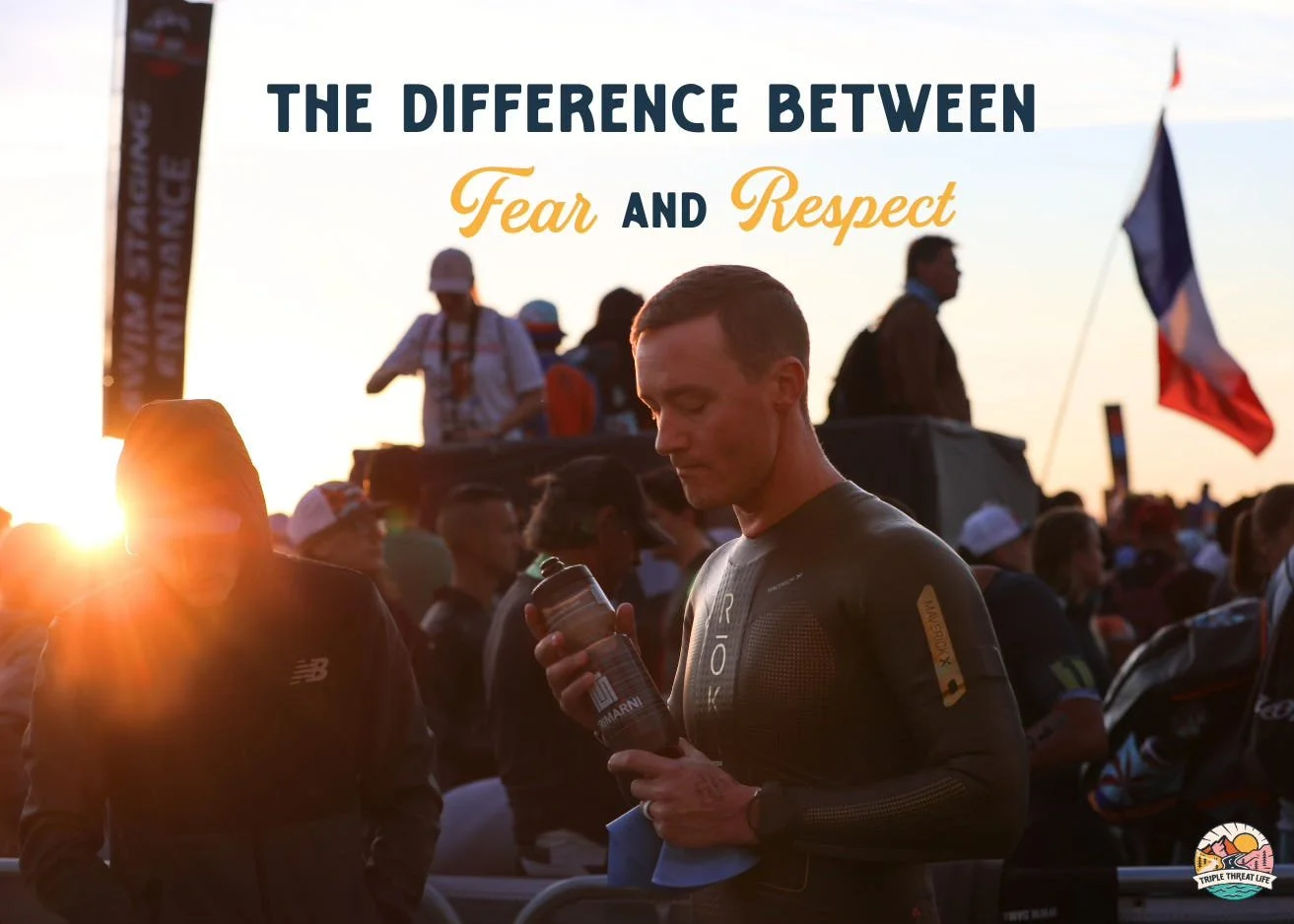
Fear is a normal emotion, uncomfortable, but not damaging on its own. When you’re fearful of something- swimming in open water, running a long distance, giving a speech, etc. it’s like your mind is showing you a yellow, caution light.
CAUTION- DANGER AHEAD- I DON’T THINK I’M PREPARED FOR WHAT COMES NEXT
Fear, on its own, isn’t necessarily a bad thing. It can highlight areas for growth, confidence, and show what you value most in life. However, it becomes a problem when you allow yourself to be controlled by fear- when it impacts your thoughts, decisions, and actions.
If I had to pick one part of a triathlon that people “fear” the most, I would say it’s the swim. Sure, you might not look forward to running a 10K, half marathon, or marathon, but there isn’t the same perceived risk to your life as there is with swimming in open water.
But, today, I want to challenge you to think about fear in a different way and show how fear of something is different than having a healthy respect for something.
What are you afraid of?
The words we use matter. Since I’m a word person, let’s look at the definition of fear from the Cambridge Dictionary.
fear- an unpleasant often strong emotion caused by anticipation or awareness of danger
That makes sense. If you’re afraid of swimming in a triathlon, you probably experience strong, unpleasant emotions when you think about it in training, when standing on the start line, or it might prevent you from signing up in the first place.
What I find helpful is to do a little introspection and figure out what it is that you’re actually afraid of. For example, fear of swimming might not be the real issue at all. It might go a bit deeper than that.
Water
I’m afraid of what’s in the water- sea creatures, waves, chop, current.
I’m afraid of swimming around so many other people and getting hit.
Ability
I’m afraid I won’t be able to cover the distance.
I’m afraid there’s no wall to hold on to and no lane lines to look at.
I’m afraid I’ll freak out in open water and have a panic attack.
Approval
I’m afraid I’ll be so slow that I will come in last and everyone will laugh at me.
I’m afraid what other people will think of my time.
You can do this exercise with any fear you might have- not just those related to sports or performance. As yourself this question: What am I really afraid of? Once you pinpoint the issue, you can take steps to address it directly.
READ MORE- 5 Causes of Open Water Swim Anxiety and How to Conquer Them
But showing you how to overcome your fears isn’t the goal of today’s newsletter. In fact, I don’t really subscribe to the notion that you learn to “conquer your fear” anyways.
I think you can be afraid and do it anyway.
Instead, I want to show that being fearful of something and having a healthy respect for something are a bit different.
Triple Threat Life is a reader-supported newsletter. If you’d like to support my writing, you can upgrade to a paid subscription here. :)
Fear Vs. Respect
Recently, a friend posted something on social media related to the distances of an Ironman. His stuff is great. It’s always inspirational and easy to relate to. (He might actually be reading this, so hi!)
The point behind the graphic he shared is that the swim portion of an Ironman is comparatively shorter than the bike and run. That’s true. For an Ironman triathlon, the distances include a 2.4-mile swim, 112-mile bike, and 26.2-mile run. That means the swim is approximately 5-8% of the total time, therefore, it’s nothing to fear.
Now, if you’re one of those athletes who has always wanted to do an Ironman someday, but are scared of the open water swim, this idea might inspire you or provide you with comfort.
“Hey, this might be something I can actually do.”
That’s great! We need more of that in the sport. But, there are those who will take it a step too far and say:
“Since the swim isn’t as long as the bike or run, I don’t really need to focus as much on it in training.”
That is a problem.
The truth is that regardless of the percentage of the total time of the race, the swim is still 2.4 miles. I will repeat. If you sign up for an Ironman, you will need to swim 2.4 miles (emphasis on miles).
Now, is this something you need to be afraid of? Absolutely not, so long as you prepare properly. If you commit to swimming 2-3 days a week, learning good form and technique, using short intervals to build endurance, using longer intervals to build confidence, practicing in open water, practicing in your wetsuit, etc. you will be just fine. (Yes, it’s a lot. As aforementioned, you’re swimming 2.4 miiilllleeess.)
Thousands of unexceptional, adult-onset swimmers do this every weekend, and they live to tell the tale. If you prepare well, you will be just fine.
However, if you don’t… Honestly, a few things could happen. If you neglect swimming because “it’s not important,” you don’t practice in open water, you hop in the pool a few weeks before the race, you plan to “just make it through” by doing whatever doggie paddle, breaststroke you come up with (not joking, seen it), the best case scenario is you make it to the time cut-off... Oh wait, that’s not the best case scenario. The best-case scenario is you live.
This is not a joke. There are ambulances standing by at these races for a reason. Being married to a doctor, and knowing a few medical directors at IM races, the swim is where they hold their breath. It’s the most anxiety-producing, stressful time for medical race personnel. Their main concern isn’t your time, pace, or enjoyment. They want you to get out of the water alive. Period.
Am I telling you this to scare you? No, I want to emphasize an important point. If you sign up for a long-distance triathlon, you need a healthy respect for the distance.
The distance doesn’t care if you didn’t train. The distance doesn’t care if you aren’t prepared. The distance doesn’t care if there’s wind, waves, and rough surf. It’s 2.4 miles (or 1.2 miles, because the same thing applies to a 70.3 triathlon) and you have to figure out how to deal with it. You have a much better chance of dealing with it well, if you’ve done the necessary training.
And it’s not just the swim. This applies for every part of the race- cycling, running, nutrition, etc. And it’s not just for the long ones either. No matter what distance of triathlon, running race, or cycling event you’ve signed up for, you need to respect the distance.
What does this look like, practically speaking?
Doing some actual research about what’s involved (before signing up, ideally.)
Acknowledging what it will take to prepare properly. Race day is just ONE day among months and months of training.
Not looking for shortcuts or hacks. There is no shortcut on race day.
Not underestimating the fitness and endurance required and not overestimating your current ability.
Not making excuses- “I’m tired, I’m busy, I have so much to do…” is not a good reason to neglect training. Modify workouts, yes. Take a day off, yes. But using that as an excuse to neglect training, no. Everyone is tired, busy, and has full-time jobs. That’s nothing special.
Put in the work. Do what it takes. Honor the investment you’ve made, not just to complete an event to the best of your ability, but also to yourself. (I mean, have you seen how much these things cost?!)
Why did I feel this was important to write today?
Because of what I see online. Every time I see one of these videos, I want to hit my head against a brick wall.
Can you get through a half ironman with little to no swim training? You can, because I did…
I’ve signed up for my first Ironman in three months, so I need to start training…
I’ve signed up for my first 70.3. I don’t really know how to swim well, but I’m not super concerned about it, because it’s the shortest part of the race…”
Sadly, I am not joking. These are real.
And the thing is, most people will be fine. They can poppycock through the swim, amble around on the bike, walk the run, and get to the finish line. For most people (especially the young ones who make these videos), the time cut-offs are pretty generous.
But, here’s the thing. Do you want to “just get through it”? I don't. Certainly not when I’ve paid $400-$1,000 to do a race. And it isn’t just about the cost. It’s about respect- for yourself and for the privilege you have to do something like this.
Also, it’s not about being fast. I don’t care if it takes you 10 hours or 17 hours to finish an Ironman. If you can say you did everything in your power to train consistently, prepare well, and do the best you could on that day, that’s all anyone can ask for.
A final word about fear
I should probably explain why I think about fear a bit differently. Consider this.
“Fear the Lord, you his holy people, for those who fear him lack nothing.”
- Psalms 34:9
Wait a second, we should fear God? That doesn’t make you feel all warm and cozy inside… But biblical fear is a bit different than how you might think about fear today.
Another word you might use to describe fear in this situation is reverence, respect, or awe. He is the Creator of all things, our Holy Father, and the reason for the breath in your lungs. That commands a certain level of respect.
Think about your own parents. I hope you didn’t fear them, but I bet you respected them. Same thing.
This makes sense when you look at the second part of the verse. We should fear the Lord because…“for those who fear him lack nothing.”
That certainly doesn’t sound like fear (unpleasant emotion, feelings of dread, awareness of danger.)
That sounds like you have everything you could ever want or need or imagine and more, in Him.
Because,
“Do not be anxious about anything, but in every situation, by prayer and petition, with thanksgiving, present your requests to God. And the peace of God, which transcends all understanding, will guard your hearts and minds in Christ Jesus.”
- Philippians 4:6-7
Thank you for reading Triple Threat Life! If you enjoyed today’s newsletter, please consider sharing with a friend.